

Have you invested in automation, expecting it to reduce your team's workload, only to find yourself managing more complexity than before?
Are your automated workflows running, but your team still spending hours on manual workarounds, exception handling, and fixing outputs that should never have needed fixing?
Automation is one of the most powerful operational investments a growing business can make. But it is also one of the easiest to get wrong. The cost of automation done poorly includes the ongoing cost of maintaining something that does not work, the time your team spends compensating for it, and the opportunity cost of results that never materialize.
At Lava Automation, we have built automation systems for more than 300 growing businesses and managed workflows across $4 billion in premium. We have also rebuilt automation that other providers built badly. The same mistakes appear consistently, and they are expensive every time.
In this article, you will learn the five most common automation mistakes costing businesses thousands of dollars and how to avoid each one.
Automating Before Your Workflows Are Documented
The most common and most costly mistake is building automation around processes that have never been clearly defined.
Automation follows rules. It executes the same sequence every time based on the conditions you set. When those conditions are based on a workflow that changes depending on who handles it, what day it is, or how busy the team is, the automation encodes that inconsistency rather than resolving it.
The result is automation that produces unpredictable outputs, requires constant manual intervention to correct, and generates more exceptions than it resolves.
The team ends up doing more work than before, now split between their original tasks and managing the automation that was supposed to remove them.
Before building automation, every workflow that will be automated needs to be documented.
Building Automation That Nobody On Your Team Can Maintain
Automation built with technical complexity that your team cannot understand or modify creates a different kind of problem. It works until it does not, and when it breaks or needs to change, you have no one to fix it.
This happens when automation is built by an external vendor who disappears after launch or when the platform requires specialized technical knowledge your team does not have.
The right automation is transparent. Your team should be able to understand what it does, identify when something is wrong, and make adjustments when your workflows change.
Automating the Wrong Tasks First
Some processes are high-volume, clearly defined, and produce the same output every time. Those are strong automation candidates. Others require judgment, context, or human relationships that automation cannot replicate.
The highest-value automation targets are the tasks that are repeatable, clearly owned, and currently consuming meaningful time from your team.
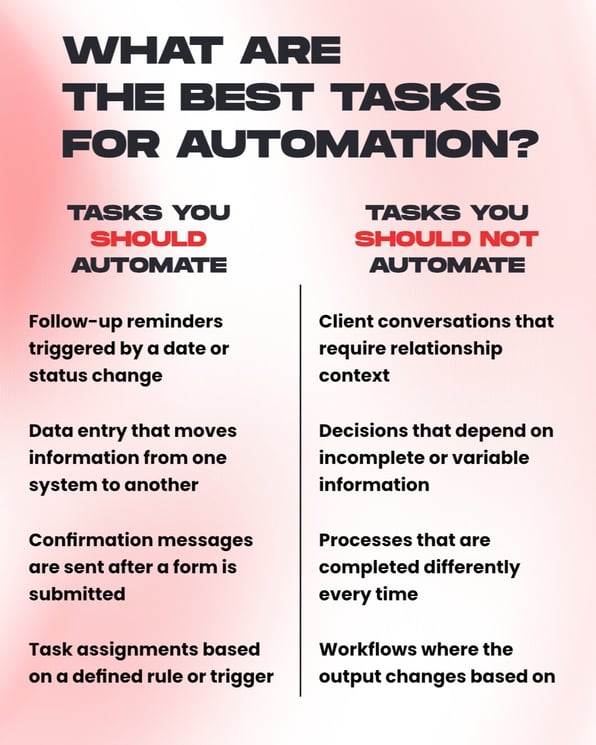
Good automation candidates:
- Follow-up reminders triggered by a date or status change
- Data entry that moves information from one system to another
- Confirmation messages are sent after a form is submitted
- Task assignments based on a defined rule or trigger
Poor automation candidates:
- Client conversations that require relationship context
- Decisions that depend on incomplete or variable information
- Processes that are completed differently every time
- Workflows where the output changes based on judgment
Identify the tasks your team completes most frequently that follow a consistent sequence and that do not require a judgment call to complete. Start there.
Treating Automation as a One-Time Project
When businesses treat automation as something to build and forget, two things happen.
First, the automation becomes outdated as workflows and team structures change around it.
Second, nobody is accountable for whether it is still performing. Slowly, without anyone making a deliberate decision, the team starts working around the automation rather than through it.
Automation that is not actively maintained and measured delivers diminishing returns over time.
Every automation system needs an owner, a review cadence, and a feedback loop that surfaces problems before they compound. The businesses that get the most from it treat it as a completed deliverable.
Expecting Automation to Replace Human Oversight
Automation handles defined, repeatable sequences. It executes instructions based on conditions.
It does not recognize when something looks wrong, when a situation falls outside its rules, or when a business relationship requires human judgment.
The most effective automation runs alongside trained human support.
Businesses that deploy automation and remove human oversight entirely discover this the hard way. Errors that a trained team member would have caught in seconds run undetected. Exceptions pile up. Client-facing outputs go out incorrectly. And the trust that automation was supposed to build gets eroded.
A virtual assistant working inside the same systems as your automation is the quality control layer that catches what automation cannot see. When automation handles volume and human oversight handles judgment, the system performs reliably at scale.
To understand how automation and virtual assistants support work together, read: Why Insurance Agencies Use Virtual Assistants with Automation.
How Do You Avoid Wasting Money on Automation?
The five mistakes in this article share the same root. Automation was treated as the solution before the conditions for it to succeed were in place.
Undocumented workflows produce unpredictable outputs. Unmaintained systems fail silently. Wrong task prioritization delivers no meaningful time back. One-time project thinking lets the system drift. And removing human oversight lets errors compound unchecked. Each mistake costs money, not just at the point of failure, but every week the problem goes unaddressed.
The fix is structural: document workflows before building, prioritize high-frequency, clearly defined tasks, build for maintainability, treat the system as living infrastructure, and keep human judgment in the loop.
At Lava Automation, we build automation systems on proven frameworks developed across hundreds of deployments and $4 billion in managed workflows. Every system is configured around your actual workflows, tested before launch, and supported after go-live by a team that stays involved.
Book a demo with Lava Automation to walk through your current workflows and identify exactly where automation would deliver the most immediate impact for your business.
Frequently Asked Questions
Why does automation sometimes create more work instead of less?
Usually, because the underlying workflow was not clearly defined before the automation was built. Automation codifies what it is given.
What tasks should be automated first?
Start with tasks that are high-volume, clearly defined, follow a consistent sequence, and do not require judgment to complete.
How do I know if my automation is still performing correctly?
Assign an owner to review automation outputs on a regular cadence. Track the volume of manual exceptions being handled alongside the automation.
Can automation replace a virtual assistant or team member entirely?
For defined, repeatable tasks with no exceptions, automation can operate independently. For anything that requires judgment, context, or handling unexpected situations, human oversight remains necessary.
What makes Lava's automation approach different?
Every automation system Lava builds starts with proven frameworks developed across hundreds of deployments. Workflows are documented and validated before any automation is built, and the system is supported after launch to ensure it continues performing as your business evolves.
