

Are you overwhelmed by tasks you cannot seem to hand off?
Do you want support but feel uneasy about giving essential responsibilities to someone offshore?
Many agency owners reach a point where the workload grows faster than their capacity.
Emails sit unanswered. Renewals wait on one desk. Certificates pile up. Even when a virtual assistant seems like the right solution, the idea of letting go can feel uncomfortable.
At Lava Automation, we have helped hundreds of insurance agencies work through this hesitation. With billions in premium supported and structured post-placement training, we have seen owners regain control by replacing memory-driven workflows with documented systems. Delegation becomes safer once the work follows a straightforward process.
In this article, you will learn why delegation feels risky, how structure protects quality, and which tasks to hand off first to build confidence without adding pressure.
Why does delegating to a virtual assistant feel risky for agency owners?
Delegation feels risky when key processes exist only in your mind. You know the clients. You understand the system. You can see the small details that drive quality. When all of that knowledge lives in one place, handing it to someone new feels uncertain.
Delegation feels unsafe when the work depends on memory instead of documented steps.
Owners may also carry the weight of past experiences. If a past handoff created extra work or confusion, that memory shapes how new opportunities feel. It becomes easy to assume the same outcome will happen again.
The real challenge comes from missing structure, because delegation only feels safe when the work follows precise and repeatable steps.
What fears keep agency owners from trusting offshore support?
Many owners share similar concerns when considering bringing in offshore help.
They worry essential details will be missed.
Certificates, renewals, and documentation require accuracy. Without clear direction, even a small mistake feels costly.
They worry tasks will disappear from view.
If a workflow leaves their desk, they want to know where it stands and when it will be finished.
They worry that delegation will create more work.
When expectations are unclear, owners often feel they must fix early attempts themselves.
These concerns ease once expectations are documented, checkpoints are defined, and your virtual assistant receives structured guidance after placement.
How can you delegate without losing control?
Delegation becomes reliable when control shifts from personal involvement to a documented process. A virtual assistant can complete tasks accurately when they can see each step, each file, and each checkpoint.
You keep control by making your expectations visible and consistent.
Start by outlining the workflow. Record short screen share videos. Save examples of completed work. Define how updates should happen and when you want summaries. These elements give you clarity without pulling the work back onto your plate.
Gallup reports that many entrepreneurs struggle with delegation because their standards and processes live in their heads rather than in documented systems, leading to recurring bottlenecks and stalled work.
Once you can see both the process and the progress, control no longer depends on doing everything yourself.
What tasks should you delegate to a virtual assistant first?
Early success comes from choosing work that follows a predictable pattern. These tasks often take significant time but involve clear steps.
Start with tasks that repeat every week and follow a stable workflow.
Examples include:
1. Renewal preparation
2. Certificate processing
3. CRM updates and documentation
4. Document gathering and file organization
5. Scheduling, reminders, and inbox support
These handoffs create immediate relief and build trust in the partnership.
For additional examples of day-to-day responsibilities, read What Can a Virtual Assistant from Lava Automation Do?
How do you build a structure that makes delegation feel safe?
Structure is what turns delegation into a reliable system. A virtual assistant performs well when they know what success looks like and how you want the work handled.
Clear instructions, consistent updates, and steady feedback create dependable results.
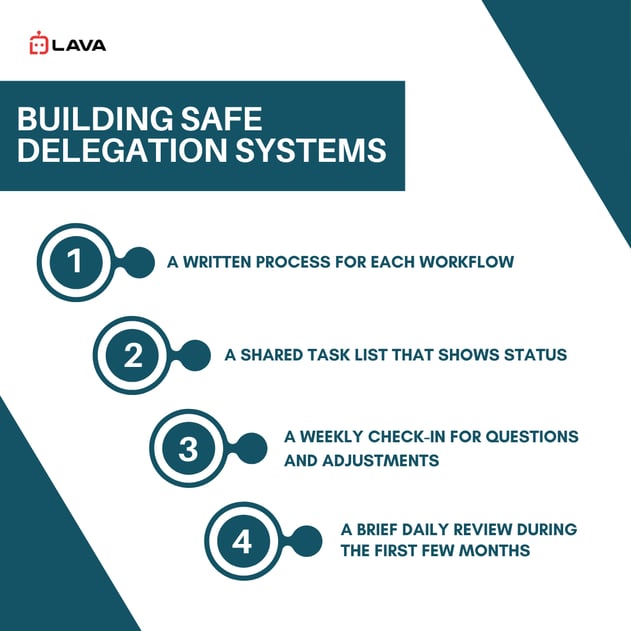
Consider building:
A written process for each workflow
A shared task list that shows status
A weekly check-in for questions and adjustments
A brief daily review during the first few months
This structure gives your virtual assistant guidance and gives you visibility. Delegation then feels like a planned process instead of a risky step.
How do you maintain quality as you delegate additional responsibility?
Quality grows through repetition and specific direction. During the early stage of delegation, your focus should be on creating a rhythm of work and feedback.
Quality improves when corrections are specific and delivered consistently.
Instead of general statements, point to a field, a note, or a step. Save examples of correct work for future reference. These details help your virtual assistant better match your expectations.
As consistency improves, you can reduce the amount of review while keeping simple checks in place.
How do you know when you are ready to expand delegation?
You are ready to expand when the first set of tasks feels stable. You see work moving on schedule. You see your standards reflected in the output. You receive updates without having to request them.
Consistency is the signal that your system can support additional responsibility.
Signs include:
Timely completion
Minimal corrections
Clear summaries
Proactive communication
Add one new workflow at a time. Guide early attempts. Allow patterns to stabilize before adding more.
How do you move forward once delegation feels possible?
Letting go becomes easier when your processes are documented, and your expectations are clear. Delegation starts to feel safe when your virtual assistant shows consistent progress and your workflows move without constant oversight. The pressure you have been carrying begins to ease because the work follows a structure that protects your standards.
Agency owners who invest time in early guidance often see momentum build. Tasks move on schedule. Documentation becomes consistent. Communication feels predictable. You begin to see how much time returns to your day once the work follows a stable routine rather than relying on constant involvement from you.
At Lava Automation, we have supported hundreds of agencies as they shift from memory-driven work to documented systems. We have seen how clear workflows, steady training, and structured oversight give virtual assistants the context they need to perform well from the beginning.
If you want to understand how early training shapes results, read How Lava Automation Handles Virtual Assistant Training. It explains how structured guidance helps your virtual assistant deliver steady, accurate work in your environment.
Virtual assistant delegation FAQ
How do I prevent mistakes when delegating?
Start with documented steps and review a small sample of work each day during the first stage of onboarding.
How much training does a virtual assistant need?
Every virtual assistant needs training after placement so they can learn your workflows, your systems, and your expectations.
Which tasks are safest to delegate first?
Workflows like renewal preparation, certificates, CRM updates, and scheduling are a reliable place to begin.
How do I maintain visibility on delegated work?
Use simple checklists, shared dashboards, or short written updates that summarize progress.
When will I feel confident enough to delegate more?
Confidence grows when you see accuracy, clear communication, and consistent delivery.
