

Are you considering hiring a virtual assistant but worried it will add to your management burden?
Do you wonder how many hours you will need to invest before seeing real ownership?
For many business owners, “stretched thin” looks like missed follow-ups, delayed renewals, overflowing inboxes, and leaders stepping back into administrative work just to keep operations steady.
At Lava Automation, we have onboarded and trained hundreds of virtual assistants through a structured, multi-week framework that guides them from orientation to certified workflow ownership.
Bringing on a virtual assistant does not have to create endless correction cycles. With the right structure, most businesses see measurable task ownership within 30 to 45 days and reclaim meaningful leadership time by month two. Here is what that timeline looks like and why structured onboarding succeeds where informal delegation fails.
How Much Time Does It Take to Train a New Virtual Assistant?
Most businesses dedicate five to ten hours per week during the first month.
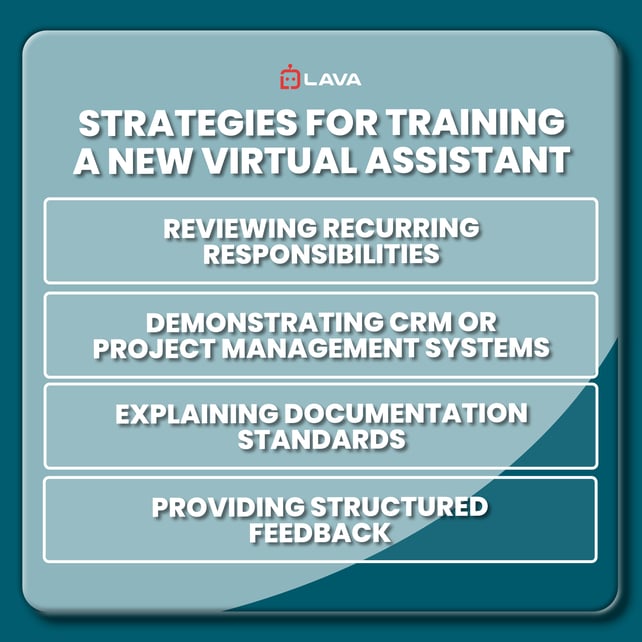
That time includes:
Reviewing recurring responsibilities
Demonstrating CRM or project management systems
Explaining documentation standards
Providing structured feedback
Those hours can feel heavy at first. Leaders often worry that they are adding work rather than removing it.
The first 30 days determine whether your virtual assistant becomes a lever or a source of long-term friction.
When onboarding is structured, repeatable tasks begin transitioning by week four. Without structure, correction cycles drag on for months, and leaders quietly resume doing the work themselves.
Five focused hours today can prevent dozens of corrective hours later.
If five hours feels impossible, it often means you are already spending ten hours reacting to problems. Structured onboarding focuses effort up front so it does not expand indefinitely.
What to Expect in the First 90 Days of Virtual Assistant Training
Clear progression creates predictable results.
Phase 1: Foundation and Orientation
The first stage establishes clarity around role, systems, and expectations.
This includes:
Role definition
Communication standards
CRM navigation
Task routing
Data entry protocols
If automation tools are involved, assistants learn workflow triggers and sequencing.
Clarity established in the first two weeks prevents months of correction later.
Phase 2: Systems Mastery and Role Education
Assistants then move into deeper systems education.
For insurance agencies, this often includes leading AMS platforms, raters, ACORD documentation, and carrier workflows. In broader industries, this translates into mastery of your CRM, billing platform, scheduling system, and reporting dashboards.
Without this phase, assistants rely on guesswork.
Guesswork leads to corrections.
Corrections stall growth initiatives and consume leadership time.
Systems education reduces avoidable errors and increases execution confidence.
We often see businesses attempt informal delegation before formal onboarding. The difference in stability becomes clear within the first month.
Phase 3: Application and Certification
Learning transitions into supervised execution.
This phase includes:
SOP validation
Escalation protocols
Workflow testing
Performance checkpoints
Certification confirms readiness before expanded ownership.
Validation protects quality before complexity increases.
Phase 4: Ongoing Coaching and Expansion
Training does not end after onboarding.
Weeks six through twelve focus on:
Efficiency refinement
Communication strengthening
Expanded workflow ownership
Performance review
We regularly see leadership teams regain multiple hours per week by month two once structured delegation stabilizes.
Ongoing coaching turns short-term support into long-term operational infrastructure.
4 Reasons Virtual Assistant Onboarding Fails Without Structure
Many leaders say, “We tried this before, and it didn’t work.”
In most cases, the issue was not the assistant. It was the absence of structure.
Most onboarding failures stem from structure gaps, not talent gaps.
1. Experience Is Expected to Replace Alignment
Even strong hires require system alignment and expectation clarity.
Without structured onboarding, assistants interpret standards differently than leadership intends.
2. Systems Education Is Skipped
Leaders delegate tasks without teaching workflow logic.
The assistant completes the steps incorrectly. Corrections pile up. Trust slows. Eventually, the owner resumes control of key tasks.
The cost becomes lost sales, delayed growth initiatives, and rising burnout.
3. Boundaries Are Undefined
Clear task boundaries create operational confidence.
Virtual assistants can support quoting preparation, appointment setting, CRM development, document handling, and workflow processing. They cannot discuss coverages, bind policies, or submit policy changes that affect coverage or premium.
Training must clarify escalation steps for licensed activity or decision authority.
Defined guardrails accelerate safe delegation.
4. Independence Is Expected Too Soon
Delegating advanced workflows before validation creates instability.
Progression builds stability. Pressure creates correction cycles.
Does AI Reduce the Amount of Virtual Assistant Training Required?
AI tools assist with drafting, summarizing, and automating. They still require structured data inputs and human oversight.
An AI system may draft a renewal email using outdated policy details pulled from incomplete CRM fields. Without human review, that error reaches the client.
Automation workflows can also fail to escalate requests that require licensed approval.
Technology accelerates tasks. Training safeguards execution.
If you’re evaluating whether automation can replace structured onboarding entirely, your next step is to read How Virtual Assistants Improve AI Workflows and Why You Still Need One, where we break down the limits of AI in client-facing workflows.
Putting It Into Practice
At the beginning, training requires focused effort. Without structure, onboarding feels unpredictable and exhausting.
With structure, tasks stabilize. Response times improve. Leaders stop stepping back into administrative work and return to revenue-producing activities, client relationships, and strategic growth.
The difference between friction and leverage is structure.
If your team is already stretched thin and correction cycles are consuming leadership time, structured onboarding becomes a growth decision.
When hiring fails, it is rarely because support cannot work. It fails when the structure is missing.
At Lava Automation, we guide businesses through defined onboarding frameworks that include systems mastery, certification checkpoints, and ongoing coaching.
Schedule a demo and see how structured training accelerates results without overwhelming your team.
Frequently Asked Questions
How many hours per week should I plan for training?
Five to ten hours per week during the first month is realistic for most businesses.
When does a virtual assistant become productive?
Many assistants begin handling repeatable tasks within 30 to 45 days when onboarding follows a structured progression.
Can businesses onboard independently?
Yes. Businesses that clearly document workflows and allocate time for coaching can build internal systems. Structured programs reduce variability and shorten ramp-up time.
I don't have time to train someone.
Lack of time often signals workflow bottlenecks. Structured onboarding reduces reactive corrections and the need for long-term supervision.
Does AI reduce training time?
AI supports efficiency. It does not replace structured onboarding, escalation clarity, or accountability.
