

If you’ve ever booked a demo for a virtual assistant only to realize afterward that the pricing doesn’t fit your budget, you’re not alone.
Many insurance agencies spend time in sales conversations without clear cost expectations, while still dealing with missed follow-ups and licensed producers stuck in administrative work.
At Lava Automation, we’ve helped more than 300 agencies evaluate virtual assistant pricing and implement systems that combine automation with structured support. We’ve seen where confusion happens and what buyers actually need to make a confident decision.
In this article, you’ll learn exactly what a Lava virtual assistant costs, what’s included, how it compares to hiring in-house, and how to decide if it’s the right investment for your agency.
How Much Does a Lava Virtual Assistant Cost Per Month?
Lava virtual assistants are priced at $14 to $15 per hour, billed biweekly. For a full-time placement, that comes out to roughly $2,400 to $2,600 per month.
The pricing structure is intentionally simple. There are no hidden fees or fluctuating rates. The only factor that affects the cost is whether you require specialized skills such as design, bookkeeping, or development.
There is also a six-month minimum commitment. After that, most agencies continue month-to-month as they scale.
What Is Included in the Monthly Cost?
A lot of agency owners have been burned by low hourly rates that turned out to be freelancers on personal laptops, with no oversight or accountability when something went wrong.
Lava’s rate supports a complete system built around your placement.
Out of thousands of applicants we receive every month, fewer than 1% advance to client interviews after background screening, written testing, and structured evaluation. Every placement includes:
- A dedicated virtual assistant matched to your workflows
- Secure Lava-issued equipment
- Role-based access aligned with SOC 2 Type 1 certified standards
- Ongoing performance coaching
- Replacement support if performance falls short
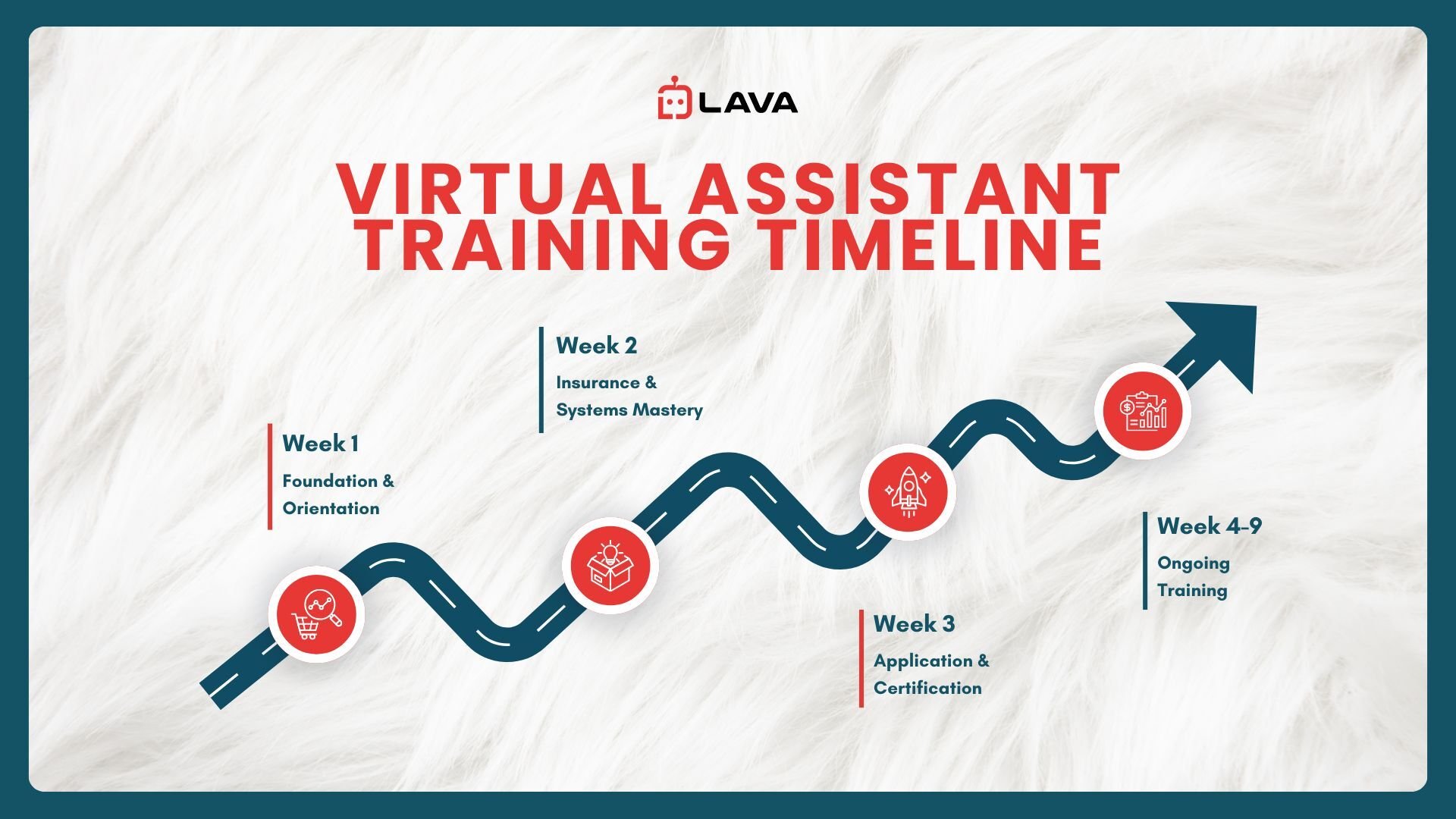
During the first six weeks, your virtual assistant completes Lava University coursework in the mornings and works directly inside your systems in the afternoons. By month three, most are working independently.
How Does This Compare to Hiring In-House?
Hiring in-house comes with significantly higher total costs. A full-time administrative employee in insurance typically earns between $3,500 and $6,500 per month in salary alone, before adding benefits, taxes, equipment, and recruiting time.
In most cases, a Lava virtual assistant costs less while also improving efficiency.
Another key difference is how work is supported. With an in-house hire, you are responsible for building processes and oversight. With Lava, your virtual assistant operates within an established system that guides execution.
If you want to understand what tasks a virtual assistant can take off your team’s plate and how that connects to cost, review a breakdown of real agency workflows and responsibilities → What Can a Virtual Assistant from Lava Automation Do?
.png?width=1920&height=1080&name=ArticleWebsite%20Graphics%20(6).png)
What Should You Expect in the First 60 Days?
Week one is orientation. Your virtual assistant meets your account manager, builds a training plan around your systems and carriers, and begins foundational insurance training.
Week 1: Orientation, system access, and foundational insurance training
Weeks 2 to 6: Mornings are spent at Lava University. In the afternoon, they focus on your agency, handling certificate requests, CRM updates, inbox management, and renewal prep
Month 3: Tasks move without prompting. Licensed staff stop absorbing administrative work.
Most agencies see their virtual assistant handling core responsibilities independently within 30 to 60 days.
The agencies that get there fastest are the ones that show up with a few things already in place. These things include:
- Clear task ownership so your virtual assistant knows exactly what they own and what done looks like.
- Short daily check-ins during the first 30 days to confirm priorities and catch anything before it compounds.
- Documented workflows so they can work independently without waiting on you.
Lava provides the structure, the training, and the oversight. What moves the needle on your end is clarity and a willingness to delegate with intention.
Are There Other Pricing Tiers?
For agencies that want automation and CRM infrastructure built alongside virtual assistant support, Lava offers three additional service options. These are one-time project costs, and not monthly subscriptions.
Group — $6,000: Workflow mapping and CRM setup with templated configuration, plus a dedicated virtual assistant. Best for agencies that need a structure built quickly.
One-on-One — $12,000: A fully custom CRM build, direct strategy sessions, and a dedicated virtual assistant. Best for agencies ready to build a purpose-designed operational system.
One-on-One Automation Only — $20,000: The same custom CRM build and strategy work without virtual assistant placement. Best for agencies that want the automation foundation established first.
Optional ongoing support is available after any of these engagements.
Is This the Right Investment for Your Agency?
At $14 to $15 per hour, you are bringing in a trained professional operating within a system with rigorous selection, structured training, secure equipment, and SOC 2-certified oversight.
If your licensed team spends meaningful hours on work that does not require their license and your workflows are well-documented enough to hand off, this model is likely to pay for itself within the first few months. Agencies using Lava reclaim 15-20 staff hours per week.
If your processes are still inconsistent or your team is not ready to delegate, build that foundation first. The placement works best when there is something stable to plug into.
[Book a demo with Lava Automation] if you are ready to understand what this would look like inside your agency, map your workflows, identify delegation opportunities, and see how a virtual assistant fits into your operations.
Frequently Asked Questions
What is the hourly rate for a Lava virtual assistant?
$14 to $15 per hour, billed biweekly. Full-time placement runs roughly $2,400 to $2,600 per month.
Is there a long-term contract?
There is a 6-month minimum for virtual assistant placement. Most agencies continue month-to-month after that. CRM setup projects are one-time costs with optional ongoing support available.
What is included in the monthly cost?
Dedicated placement, post-placement training through Lava University, secure Lava-issued equipment, SOC 2 Type 1 certified access controls, ongoing coaching, and replacement support if needed.
How quickly will my virtual assistant be productive?
Most virtual assistants are handling core responsibilities independently within 30 to 60 days. The first six weeks combine Lava University training with hands-on work inside your agency.
What if my virtual assistant is not the right fit?
Lava provides retraining first. If performance still falls short, we replace the placement without disrupting your workflow.
When does a virtual assistant make more sense than hiring in-house?
When your back-office work is repeatable, your workflows are documented, and your licensed staff are spending time on tasks that do not require their license.
