

Do you feel like your virtual assistant should be saving your team time, but instead you are correcting mistakes and answering repeated questions?
Have you added support, yet your workload has not changed the way you hoped?
Virtual assistants can strengthen insurance operations by reducing administrative pressure, improving documentation, and keeping tasks moving. This only happens when the role is aligned with clear expectations and dependable processes.
At Lava Automation, we have supported hundreds of insurance agencies as they integrate virtual assistants into daily operations. With billions in premium managed across our systems and thousands of hours returned to agency teams, we understand where virtual assistants create value and where misalignment creates friction.
In this article, you will learn the five most common signs your agency is misusing its virtual assistants and how to correct the model, so your team gains time, accuracy, and control.
1. Your virtual assistant receives unclear tasks and unpredictable outcomes follow
When tasks are handed off through quick messages, partial instructions, or shifting preferences, your virtual assistant must rely on interpretation. Insurance tasks depend on specific details. Without those details, results vary.
A virtual assistant needs a clear picture of what the final product should look like. When that picture changes from person to person, even simple responsibilities become confusing. Errors appear during busy seasons when directions shorten, and assumptions increase.
This challenge becomes visible when:
Priorities shift midtask
Staff complete the same workflow in different ways.
Instructions happen through verbal shorthand.
Clarity creates predictability. When expectations stay the same, your virtual assistant can complete tasks without hesitation.
2. Your virtual assistant is asked to perform before they understand your systems
Many agencies hope for immediate productivity, but a virtual assistant needs time to learn the tools, naming conventions, communication style, and accuracy expectations inside your agency. When onboarding is rushed or improvised, the virtual assistant relies on trial-and-error.
A structured ramp gives them the information they need to complete tasks confidently.
A helpful onboarding plan includes:
Week 1: Orientation and access
Walk through your AMS and CRM, share examples, and explain communication norms.
Week 2: Observation and simple task
Have the virtual assistant shadow renewals, certificates, and standard service workflows.
Week 3: Guided repetition with feedback
Review accuracy together so expectations are clear.
Week 4: Independent work on documented processes
Predictable tasks reinforce accuracy and momentum.
Most virtual assistants reach a dependable level of performance between 30 and 60 days after onboarding is planned.
3. Your virtual assistant delivers different results each time because workflows rely on memory
When workflows are described verbally, each person recalls them differently. That variation becomes more noticeable when a virtual assistant follows instructions that change from one example to the next.
Documentation removes uncertainty. It also keeps work consistent when multiple team members delegate tasks throughout the week.
Clear workflows help a virtual assistant understand precisely how your team expects tasks to be completed. Screen recordings, short walkthroughs, and annotated examples provide your virtual assistant with references they can refer to repeatedly.
Effective documentation includes:
Ordered steps
Screenshots or short recordings
Naming conventions
A review point for quality control
If you want help creating process guides, read How Do You Write Better SOPs for Insurance Agencies? for a simple structure that reduces rework.
4. Your virtual assistant works without steady communication and loses alignment
A virtual assistant cannot see the full context of your day. They rely on you for insight into shifting priorities, client sensitivities, and exceptions that appear during renewal spikes or service backlogs. When communication becomes irregular, the virtual assistant must interpret what matters most.
This often leads to duplicate work, stalled tasks, or repeated questions. Inconsistent communication can also affect confidence, especially when the virtual assistant is unsure if their output meets your expectations.
Teams that stay aligned usually depend on:
Short daily or frequent check-ins
These conversations help establish the day's focus and reduce uncertainty.
A shared task dashboard
Everyone sees progress, stalled tasks, and items that need attention.
Balanced feedback
Clear examples of strong work and open correction build trust on both sides.
Communication gives the virtual assistant direction. Without it, tasks become isolated and less connected to your agency’s goals.
5. Your agency replaces virtual assistants repeatedly, yet the challenges remain the same
If you have brought in several virtual assistants and continue to face similar frustrations, the issue likely stems from the environment they enter. A new virtual assistant inherits the same gaps in clarity, documentation, or communication that affected earlier ones.
Turnover interrupts momentum and adds more work for your internal team. When the underlying causes do not change, each virtual assistant experiences the same obstacles.
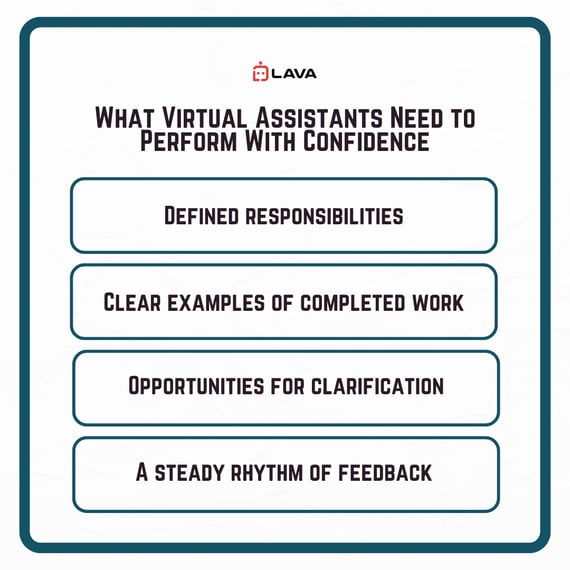
A virtual assistant performs with confidence when your agency provides:
Defined responsibilities
Clear examples of completed work
Opportunities for clarification
A steady rhythm of feedback
Adjusting these elements reduces friction and helps a virtual assistant stay engaged long term. Once your workflows and expectations become predictable, the virtual assistant becomes a dependable extension of your team.
How do you create a model that supports dependable performance from a virtual assistant?
Many agencies identify these signs when daily demands outpace their internal workflows. In this article, you learned how unclear expectations, rushed onboarding, undocumented processes, irregular communication, and repeated turnover affect virtual assistant performance. These challenges stem from a setup that does not provide the virtual assistant with the clarity needed for steady results.
When agencies shift their approach, progress often appears quickly. Tasks move more smoothly, accuracy stabilizes, and licensed staff regain time for responsibilities that require their expertise. A virtual assistant becomes dependable when the surrounding environment sets them up to succeed.
At Lava Automation, we help agencies build models that align people, tools, and workflows. With hundreds of agencies supported and billions in premium managed across our systems, we understand the level of clarity and guidance needed to help virtual assistants thrive in insurance operations.
To continue strengthening your structure, read How to Troubleshoot Problems with Virtual Assistants and see adjustments that create momentum right away.
Frequently asked questions
How long does it take for a virtual assistant to reach a steady rhythm?
Most virtual assistants reach consistency between thirty and sixty days when onboarding, documentation, and feedback are steady.
Can a virtual assistant communicate with clients?
Yes. A virtual assistant can send updates, gather information, and confirm details. Licensed staff should handle anything related to coverage or policy decisions.
What should I do if my virtual assistant seems inconsistent?
Review your workflows, documentation, and communication habits. Inconsistency usually signals unclear expectations.
How do I know if my virtual assistant is aligned with the right tasks?
A virtual assistant should own documented, repeatable administrative work that supports licensed staff.
What improves virtual assistant retention?
Clear expectations, structured onboarding, steady communication, and dependable documentation help virtual assistants stay engaged long term.
