

Do you feel hesitant to outsource overseas because you worry a detail may be missed or a client may experience a delay?
Have you heard stories of agencies trying outsourced help only to spend more time correcting mistakes or rebuilding trust?
Many agency owners feel the same uncertainty. Insurance work carries weight. Every certificate, renewal, and update affects a client relationship. When leaders consider outsourcing, they often imagine losing visibility or creating risk without meaning to.
At Lava Automation, we have supported hundreds of agencies as they evaluate outsourcing and bring on trained virtual assistants. With billions in premiums supported across our systems, we understand the pressure leaders feel when they consider letting someone outside their office handle daily tasks. The hesitation usually comes from a lack of structure, not a lack of potential.
In this article, you will learn why outsourcing fears often appear, how training and oversight create consistency, and what agencies experience once the right support is in place.
Why do agencies hesitate when considering overseas support?
Insurance leaders often associate outsourcing with unclear expectations, inconsistent work, or communication delays. They have heard examples of tasks moving slowly, details being overlooked, or progress being harder to track than expected.
These concerns usually stem from the uncertainty of how the work will be handled. Leaders want confidence that every step will follow a predictable pattern. They want to know that updates will arrive on time and that staff will not need to chase tasks throughout the day.
The hesitation is understandable. Agency operations depend on accuracy, timely responses, and organized workflows. When leaders cannot see how support will be trained or guided, the entire idea of outsourcing begins to feel risky.
Where do outsourcing challenges usually come from?
Most issues arise when support begins without a clear process. If steps are not documented, a virtual assistant must interpret how tasks should be completed. That interpretation leads to differences in quality and timing.
Communication patterns can also create slowdowns. If questions are not addressed quickly or if updates do not follow a predictable rhythm, both sides may feel uncertain. This uncertainty often grows during the first month when a virtual assistant is learning the agency’s workflows.
Another challenge appears when agencies expect immediate independence. Even a trained insurance virtual assistant needs time to learn your systems, carriers, preferences, and communication style. Agencies that do not prepare for a learning period may feel overwhelmed or unsure during the early weeks.
These problems begin long before location becomes a factor. They come from a missing structure around training, documentation, and oversight.
How does training create dependable outsourced support?
Training turns expectations into consistent results. When agencies take time to show how tasks should be completed, virtual assistants gain clarity that supports accuracy.
During onboarding, a virtual assistant observes how your team communicates, how carriers respond, and how each workflow moves from start to finish. This helps them understand the patterns and preferences that shape your daily work.
Training also reduces assumptions. Instead of guessing how to handle a request, a virtual assistant follows a documented sequence that reflects your agency’s standards. This creates predictable outcomes and faster alignment with your staff.
A structured onboarding period gives your team confidence that responsibilities are handled correctly and consistently.
How does oversight maintain quality once outsourcing begins?
Oversight strengthens consistency. It keeps tasks aligned with your expectations and ensures your virtual assistant receives guidance at the right moments.
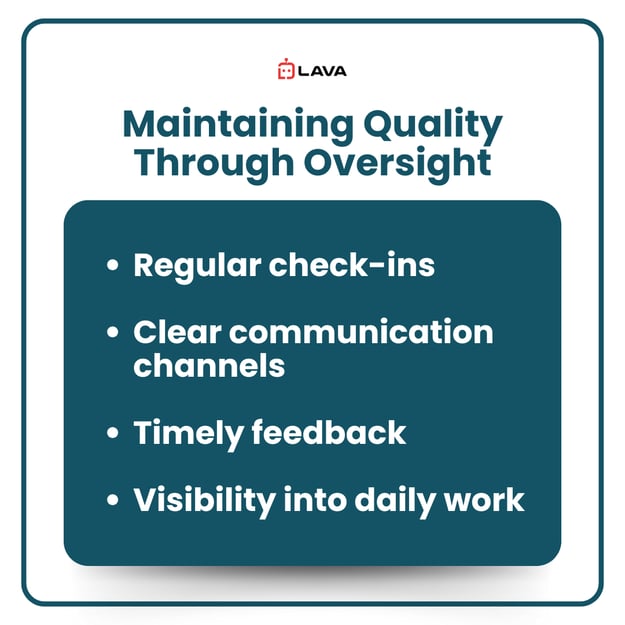
Oversight often includes:
Regular check-ins
Clear communication channels
Timely feedback
Visibility into daily work
These steps prevent misunderstandings and help both sides stay aligned as the virtual assistant learns more about your workflows. Agencies that maintain this structure experience fewer surprises and smoother handoffs.
Oversight also supports continuous improvement. As your virtual assistant becomes more familiar with your processes, you can gradually expand their responsibilities or refine existing workflows.
When oversight is part of your rhythm, support remains accurate and stable.
How does outsourcing help licensed staff focus on clients and revenue?
When a trained virtual assistant takes ownership of administrative work, your team gains steady progress in areas that often cause slowdowns. Certificates, updates, inbox management, and renewal preparation move forward without pulling licensed staff away from client conversations.
This shift often creates relief within weeks. Teams experience fewer backlogs and more predictable days. Producers and account managers have more time for proactive outreach because daily tasks no longer compete for attention.
Agencies often notice that staff feel more organized and less overwhelmed. The pace becomes calmer because responsibilities are distributed more effectively.
Outsourcing gives licensed staff space to focus on work that builds relationships and supports growth.
What changes do agencies notice once early hesitation fades?
Once the structure is in place, agencies begin to see consistent progress. Tasks are completed on time, communication becomes smoother, and staff have a clearer rhythm for each day.
Team members often feel more supported because repetitive work no longer stacks up.
Leaders gain visibility into what is being handled and how fast it moves. The agency operates with more predictability, and clients benefit from timely responses.
As confidence grows, outsourcing becomes part of normal operations rather than an uncertainty. Agencies often expand their use of virtual assistants because the structure behind the support continues to reinforce stability.
The original hesitation fades when leaders see how reliable the system becomes over time.
How agencies move from hesitation to structured progress
Many agency owners delay outsourcing because they want to protect their team, their clients, and their reputation. The pressure to maintain accuracy can make any new process feel intimidating.
Once workflows are documented, communication is consistent, and training supports each task, agencies experience steady progress. Staff gain more time for clients, and operations become easier to manage.
At Lava Automation, we guide agencies through this transition with structured onboarding, secure systems, and training designed specifically for insurance workflows. With billions in premium supported on our systems, we help teams build predictable operations that support long-term growth.
If you want to see which responsibilities agencies delegate first and how those tasks improve daily operations, read What Can a Virtual Assistant from Lava Automation Do?
Frequently asked questions
Will outsourcing lower the quality of our work?
Quality improves when processes are documented, and communication is consistent. Clear expectations support accurate results.
How long does onboarding usually take?
Most virtual assistants begin contributing within thirty to sixty days when guided with structured training and feedback.
Can a virtual assistant handle compliance-sensitive responsibilities?
Yes. Lava Automation uses secure devices, SOC 2-certified systems, and continuous monitoring to protect client information.
Do we need SOPs before hiring a virtual assistant?
No. Many agencies build documentation during training. Clarity develops naturally as both sides learn the workflow.
Which tasks should be delegated first?
Start with structured administrative work such as certificates, inbox organization, and CRM updates.
