

Are you managing three or four different IT vendors and still not confident that your business is fully protected?
Have you invested in security tools over time, only to realize that no single person is responsible for making sure they work together?
Most growing businesses build their IT environment the same way. A problem arises, a tool is added, a vendor is hired, and the cycle repeats. Each purchase feels like a reasonable response to a real concern.
But over time, what looked like a security strategy becomes a fragmented collection of tools with no single owner and no guarantee that any of it is working the way it should.
At Lava Automation, we manage IT and security infrastructure for more than 300 growing businesses. The most common situation we walk into is a business that pieced together its IT stack and assumed that was enough.
In this article, you will learn why fragmented IT creates hidden costs and real security risk, and what a structured alternative actually looks like.
Why Do Most Businesses End Up With Multiple IT Vendors?
It starts as a series of reasonable decisions made at different points in the business's growth.
- The first employee gets a company laptop. Someone sets up antivirus software.
- A data breach makes the news, so a firewall gets added.
- A vendor recommends a monitoring tool.
- A compliance requirement triggers another purchase.
Each decision addresses a specific problem at a specific moment.
The result is an IT environment built on individual reactions rather than a unified strategy.
No single vendor knows what the others are doing. No single person owns the full picture. And the gaps that exist between tools, the places where one vendor's coverage ends and another's begins, are exactly where attackers look for entry points.
What Does IT Vendor Fragmentation Actually Cost?
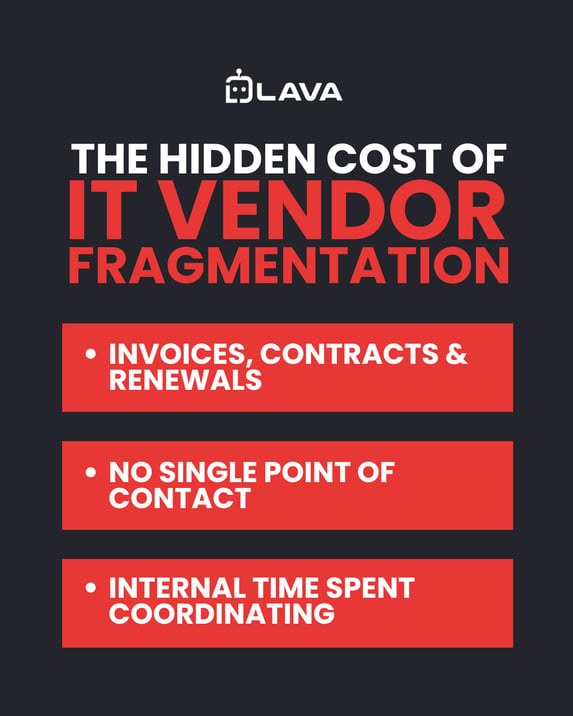
The financial cost is the most visible part of the problem. Managing multiple vendors means:
- Separate invoices, contracts, and renewal dates to track
- Multiple support lines with no single point of contact
- Internal time spent coordinating vendors
For a growing business without a dedicated IT function, that burden falls on whoever is available, usually the business owner or an operations leader with more important work to do.
When something goes wrong, every vendor points the finger at the others, and nobody owns the outcome.
Identifying the root cause requires coordinating across multiple tools and support queues. By the time the source is found, the damage is already done.
There is also the cost of configuration gaps. Tools purchased separately are rarely configured to work together:
- An endpoint protection tool that does not communicate with your email security system creates blind spots that neither vendor can see
- A password manager not integrated with your access controls leaves credential management to individual employees
- Monitoring tools that do not share data miss threats that span multiple systems
Each gap is a potential entry point that nobody is actively watching.
Why Does Fragmented IT Create Security Risk?
Effective security depends on coordination across every layer of your environment.
When someone monitors the full picture in real time, threats get caught early. But when tools operate in isolation, with no single owner overseeing them, the gaps go unnoticed until the damage is done.
The businesses hit hardest by breaches often have the most tools and the least coordination between them.
Fragmentation creates risk at every level:
- Patch management falls behind when nobody owns the schedule across all devices
- Access controls become inconsistent when different vendors manage different systems
- Monitoring gaps appear between tools that were never designed to share data
And when a credential is compromised, the time it takes to detect and contain the incident depends entirely on whether someone is watching it all.
What Does a Unified IT Approach Actually Look Like?
A unified IT approach means one partner owns your full technology environment.
Endpoint protection, email security, identity and access management, dark web monitoring, patch management, and Security Operations Center monitoring are all configured to work together, maintained consistently, and monitored by a team that sees everything in real time.
When one partner owns the full environment, there are no gaps between vendors because there are no vendors to fill those gaps.
Response times improve because there is no coordination overhead. The configuration is consistent because a single team built the entire system. Accountability is clear because one partner is responsible for the outcome.
This is also what makes the cost structure simpler. Instead of managing multiple invoices and support relationships, you pay one flat rate, and one partner handles everything.
Is a Unified IT Partner More Expensive Than Managing Vendors Separately?
This is the question most business owners ask when they first consider consolidating their IT vendors. The answer is almost always no.
When you add up the costs of separate tools, separate contracts, and the internal time spent managing multiple vendor relationships, the total cost of a fragmented IT environment is typically higher than that of a single managed service.
At Lava Automation, fully managed IT and security costs $150 per seat per month. That covers endpoint protection, email security, dark web monitoring, identity and access management, Security Operations Center monitoring, and 24x5 user support. No separate invoices. No configuration gaps. No uncertainty about who is responsible when something goes wrong.
For most growing businesses, consolidating with a single managed partner reduces both financial costs and operational burdens.
How One Managed IT Partner Reduces Cost and Security Risk
You have likely added tools over time to solve immediate problems, assuming more tools meant better protection. In reality, disconnected systems often create more risk than they solve.
Now that you understand where fragmentation creates costs and security gaps, the next step is to evaluate whether your current IT environment has blind spots.
The businesses that avoid costly breaches are those with the most coordinated infrastructure and the clearest lines of accountability.
At Lava Automation, we help growing businesses replace fragmented IT with a single, fully managed system built for security, accountability, and predictable costs. One partner. One flat rate.
Book a demo with Lava Automation to walk through your current IT environment and see exactly where the gaps are.
Frequently Asked Questions
Why is managing multiple IT vendors a problem?
Each vendor only sees and manages their portion of your environment. The gaps between tools, where one vendor's coverage ends and another's begins, create blind spots that no one actively monitors. Those gaps are where most security incidents begin.
How do I know if my IT environment has coverage gaps?
If your security tools were purchased separately over time and have never been audited as a complete system, gaps almost certainly exist.
Is consolidating to one IT partner more expensive?
Not typically. When you factor in the cost of separate tools, contracts, and the internal time spent managing multiple vendors, a single managed service is often less expensive and significantly less operationally burdensome.
What does a managed IT provider include that separate tools do not?
Coordination, consistency, and accountability. A managed provider configures every tool to work together, monitors the full environment in real time, and owns the outcome when something goes wrong.
How quickly can Lava replace my current IT setup?
Every transition is scoped during the initial consultation. Most businesses are fully onboarded within a defined timeline with minimal disruption to daily operations.
