

Are you considering signing with a virtual assistant agency to support your insurance operations?
Are you worried about choosing the wrong partner and paying for it in compliance risk or turnover?
When administrative pressure builds inside an agency, decisions often happen quickly.
Renewal tasks get delayed. Endorsements stack up. Producers are pulled into service work instead of focusing on revenue. Leadership carries the weight of protecting client data and carrier relationships. An incorrect staffing decision can increase strain rather than relieve it.
At Lava Automation, we have supported more than 300 insurance agencies and helped manage billions in premium through structured virtual assistant programs. We have also worked with agencies that came to us after difficult experiences with other providers.
In this article, you will learn the five most common virtual assistant agency red flags insurance agencies encounter and how to evaluate training depth, compliance safeguards, pricing transparency, industry specialization, and long-term support before signing any agreement.
What Are the Biggest Virtual Assistant Agency Red Flags for Insurance Agencies?
The most serious warning signs appear in five areas:
Training depth
Compliance safeguards
Ongoing coaching and oversight
Pricing transparency
Insurance industry specialization
If a provider cannot clearly explain how they train, secure, and manage their virtual assistants, your agency carries the risk.
A reliable partner should walk you through:
Length and structure of training
Systems assistants practice in
Compliance boundaries and documentation standards
What happens after placement
Vague answers create operational exposure. Clear documentation builds confidence.
Clarity around structure protects your agency from preventable mistakes.
Is “Fully Trained and Ready on Day One” a Red Flag When Hiring a Virtual Assistant Agency?
Be cautious of promises that emphasize instant productivity with no onboarding.
Every insurance agency has unique carrier workflows, naming conventions, and documentation standards. Even experienced professionals require structured ramp time inside your environment.
Sustainable performance always includes structured onboarding and guided oversight.
If a provider focuses heavily on speed and lightly on integration, ask for specifics:
What does week one look like?
Who monitors early performance?
How are errors corrected and documented?
Fast placement without structured ramp time often leads to confusion and frustration among licensed staff.
Speed without integration often creates more work for your team.
If structured onboarding and integration clarity are your biggest evaluation factors, your next step is understanding how virtual assistants support automation and AI workflows inside an insurance agency → How Virtual Assistants Improve AI and Automation Workflows
How Can Weak Compliance Safeguards Create E&O and Regulatory Risk?
Insurance agencies operate within strict compliance boundaries. Client records include financial data, policy details, and sensitive identifiers.
Red flags include:
Assistants using personal devices
No documented background checks
Undefined access controls
No monitoring or audit logs
No written process for removing access
If compliance safeguards are unclear, your agency absorbs the operational and regulatory risk.
Weak safeguards can expose agencies to:
Errors and omissions exposure
Carrier contract violations
State regulatory scrutiny
Licensing boundary confusion
Licensing boundary confusion includes unlicensed assistants discussing coverage details, advising clients, authorizing policy changes, or participating in binding activities. Those actions require a licensed professional and carry legal implications.
Compliance structure should be proactive and documented. Agencies deserve clarity around device management, data permissions, and role limitations before any contract is signed.
A defined compliance structure protects client trust and carrier relationships.
Does the Virtual Assistant Agency Provide Ongoing Coaching and Oversight?
Placement marks the beginning of performance development.
A common red flag appears when a provider steps back immediately after placement and shifts all management responsibility to the agency.
Healthy programs include:
Scheduled performance reviews
Continued education
Escalation paths for performance concerns
Structured feedback loops
Long-term performance depends on shared accountability between your agency and the provider.
Ask specific questions:
What happens at month three?
Who evaluates growth?
How is skill development tracked?
Sustained support reduces turnover and strengthens integration over time.
Ongoing coaching separates temporary help from long-term stability.
Are Virtual Assistant Agency Pricing Structures Transparent and Predictable?
Clear pricing protects budgets and expectations.
Red flags may include:
Training billed separately
Replacement fees buried in contracts
Undefined onboarding support
Unclear cancellation terms
Transparent pricing prevents surprises and reveals the true cost of support.
Request a written breakdown of:
What is included
What is optional
What triggers additional fees
Low hourly rates alone do not determine long-term value. Structure, retention, and compliance depth influence the real cost of a staffing decision.
Predictable pricing supports confident long-term planning.
Is the Virtual Assistant Agency Insurance-Specific or a General Administrative Provider?
Insurance workflows include licensing boundaries, carrier communication standards, and CRM documentation rules.
A general administrative background may support inbox management or scheduling. Insurance operations require industry context.
Ask:
Do assistants receive insurance-focused instruction?
Are they familiar with common agency management systems and CRMs?
Do they understand unlicensed task boundaries?
Insurance-specific training reduces preventable mistakes and shortens ramp time.
Specialization increases workflow stability and protects compliance boundaries.
How Do Structured and Unstructured Virtual Assistant Programs Compare?
Agencies evaluating providers often benefit from a side-by-side lens.
|
Category |
Structured Insurance-Focused Program |
General Administrative Model |
|
Training |
Documented insurance workflows and compliance boundaries |
General admin orientation |
|
Compliance |
Defined device control and role restrictions |
The agency primarily manages security |
|
Licensing Boundaries |
Defined task restrictions and escalation paths |
Often undefined or managed internally |
|
Oversight |
Ongoing coaching and performance reviews |
Limited post-placement structure |
|
Integration |
Guided onboarding inside agency systems |
Minimal ramp guidance |
Structure determines whether a virtual assistant becomes a stable extension of your team or a short-term experiment.
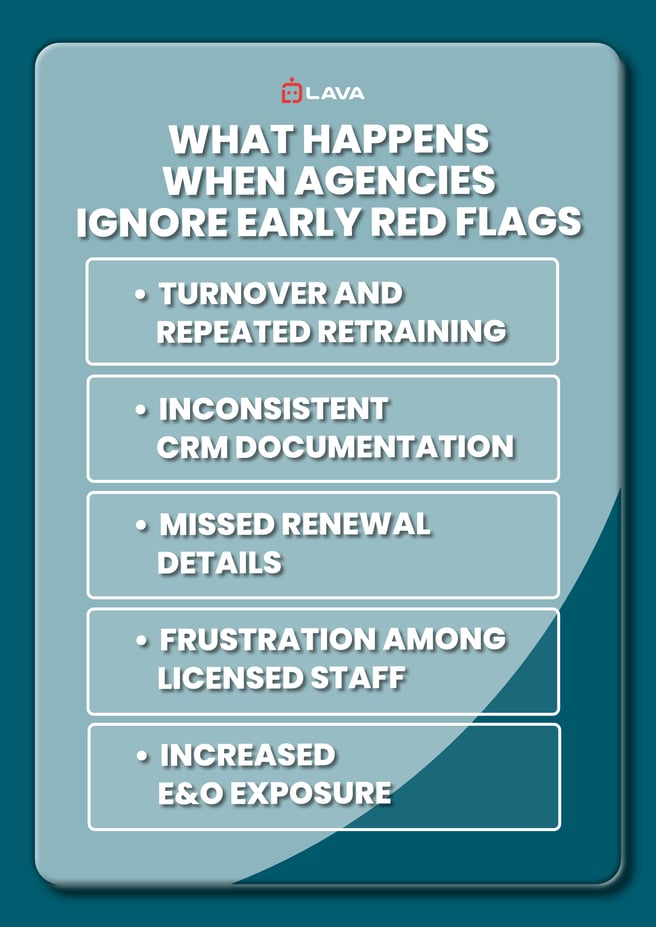
What Happens When Agencies Ignore Early Red Flags?
When early warning signs are overlooked, consequences tend to surface later.
Agencies may experience:
Turnover and repeated retraining
Inconsistent CRM documentation
Missed renewal details
Frustration among licensed staff
Increased E&O exposure
The wrong staffing structure can slow growth and increase operational stress.
Taking additional time to evaluate structure protects future productivity and preserves client trust.
Taking time to evaluate structure today protects stability tomorrow.
Bringing Structure Back to Your Hiring Decision
Administrative pressure likely prompted your search for a virtual assistant. Rushing that decision can create more strain across compliance, staffing stability, and client relationships.
Now you understand the structural red flags to evaluate before signing:
Documented, insurance-focused training
Defined compliance safeguards
Ongoing coaching and oversight
Transparent pricing
Clear industry specialization
You do not need to rush into a decision that impacts compliance, staffing stability, and client trust.
Whether you select Lava Automation or another partner, your objective remains consistent: build a compliant, stable extension of your agency that protects client relationships and supports long-term growth.
At Lava Automation, we design our virtual assistant program around structured onboarding, documented compliance safeguards, and ongoing coaching because insurance agencies require precision and accountability.
If you are evaluating virtual assistant providers and want to see what structured support looks like inside a real insurance agency, book a demo with Lava Automation today.
The right partner strengthens momentum. Careful evaluation today protects stability tomorrow.
Frequently Asked Questions
What questions should insurance agencies ask a virtual assistant agency before signing?
Insurance agencies should ask about training length, compliance safeguards, device security standards, background checks, performance reviews, and replacement policies before signing any agreement.
How long does onboarding take with a structured virtual assistant agency?
Onboarding with a structured virtual assistant agency typically takes 30 to 60 days, including supervised task ownership and guided feedback.
Can hiring the wrong virtual assistant agency create compliance risk?
Yes. Weak safeguards around data access, licensing boundaries, and documentation standards can increase regulatory and E&O exposure.
Are offshore virtual assistants risky for insurance agencies?
Offshore virtual assistants can operate successfully when supported by documented compliance safeguards, secure devices, defined licensing boundaries, and structured oversight. Risk increases when security controls, role clarity, or supervision are undefined.
