

Are you evaluating virtual assistant support but still unsure whether it actually fits where your agency is right now?
Have you watched other agencies scale with virtual assistants and wondered why the same approach might not produce the results you expected?
A virtual assistant is one of the most effective operational investments a growing insurance agency can make, but only when the conditions are right. When they are not, the virtual assistant adds coordination overhead, surfaces every gap in your operation, and costs more than it saves.
At Lava Automation, we have supported more than 300 insurance agencies through giving virtual assistant support and managing workflows across billions in premium. We have also had the harder conversations with agency owners who came to us after a hire failed.
In this article, you will learn the specific conditions that make a virtual assistant the wrong solution for an insurance agency right now.
Why Do Agencies Struggle With Virtual Assistants When Workflows Are Still Being Built?
A virtual assistant executes inside your systems. They follow the process your agency has defined. When that process does not exist yet, or changes depending on who is in the office, a virtual assistant cannot perform consistently.
This shows up most clearly in agencies transitioning to a new AMS or CRM, onboarding new carriers, or rebuilding service workflows after staff turnover. Adding a virtual assistant before operations stabilize means the assistant is learning a moving target, and the agency absorbs the cost through inconsistent outputs and constant correction.
If your agency is mid-transition, stabilize first. A virtual assistant brought in once workflows are defined will reach productive independence significantly faster.
Even when workflows are defined, another common breakdown happens when licensed staff are not prepared to hand them off.
Does Your Agency Understand What a Virtual Assistant Can and Cannot Own?
This is the most common reason virtual assistants underperform, and it rarely gets identified until months into the engagement.
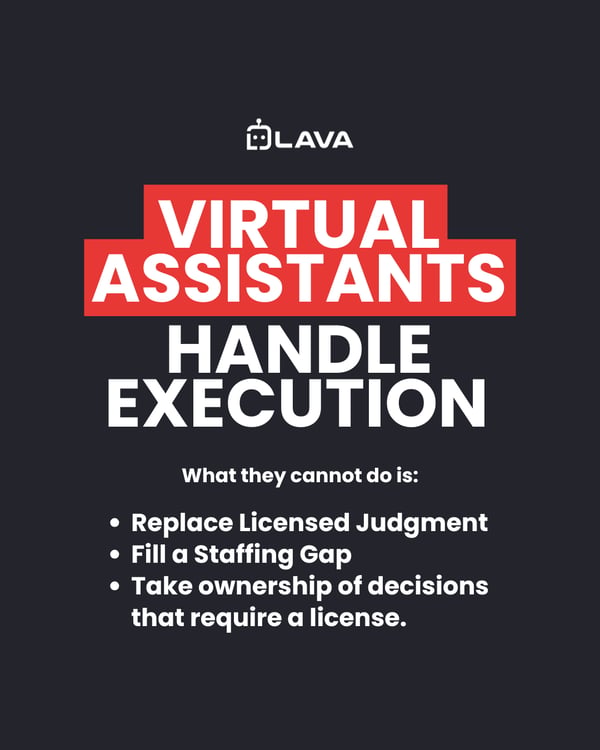
A virtual assistant handles execution. What they cannot do is replace licensed judgment, fill a staffing gap, or take ownership of decisions that require a license.
Producers and account managers who have been handling their own administrative work for years often find delegation harder than expected. When trust in the handoff has not yet been built, the licensed staff member continues to do the work themselves. The virtual assistant is technically in place, but nothing has changed.
The problem deepens when an agency is short on licensed capacity. A virtual assistant is not a replacement for a producer or operations manager. When the licensed team is already stretched, the right sequence is to hire a licensed professional first, then a virtual assistant support once the team has room to delegate.
Coverage evaluations, policy recommendations, and client advisory conversations are the responsibility of your licensed staff. The thinking stays with them. When that boundary is clear before hiring begins, a virtual assistant operates independently.
Why Does Disorganized CRM and Policy Data Create Problems for Virtual Assistants?
A virtual assistant works inside your CRM, AMS, and communication tools every day. If records are incomplete or policy data is inconsistent across systems, they will either produce errors or spend their time on cleanup instead of the work they were assigned.
Operational support requires operational clarity. A virtual assistant cannot maintain what has not been built.
Before a virtual assistant makes sense, your systems need to be navigable by someone who did not build them. Consistent naming conventions, complete client records, documented carrier portals, and a CRM that reflects current reality. Agencies that invest in that cleanup before hiring see faster ramp times and more accurate outputs from day one.
If you are still mapping out which tasks belong to your licensed team and which can be delegated, clarity at this stage shapes the success of your entire hiring decision.
Read this guide so you can identify which responsibilities your team can confidently assign and how to structure that handoff from day one → What Can a Virtual Assistant from Lava Automation Do?
Is Your Agency's Budget Stable Enough to Sustain a Virtual Assistant?
The value a virtual assistant delivers depends on consistency. Agencies that bring one in during a strong quarter and pull back when revenue dips rarely see the results they expected.
A virtual assistant reaches full potential between months three and six. Cutting the hire before that point means paying for the ramp without reaching the return.
The first 30 to 60 days are crucial. The virtual assistant is learning your systems and building independence. Treating that investment as a variable expense is what prevents most virtual assistants from ever delivering what they were supposed to.
If your revenue is inconsistent or your budget cannot sustain a reliable monthly commitment, stabilizing your financial foundation first will produce better results from any hire you make afterward.
What This Means for Your Agency
A virtual assistant is not the right solution when your workflows are still being built, your team does not understand what can be handed off, your data is disorganized, or your budget cannot sustain the commitment through the ramp.
None of these conditions is permanent. Recognizing where your agency stands is not a reason to stop considering virtual assistant support. It is the information you need to sequence the decision correctly.
At Lava Automation, we work with agencies at every stage of this readiness. When the foundation is in place, we help expand capacity through hiring a trained virtual assistant. When it needs structure, we help define the workflows that enable successful delegation.
The next step is understanding exactly where your agency stands today and what actions will move you forward with confidence.
Book a demo to walk through your agency’s workflows and receive a clear, experience-based recommendation on how virtual assistant support fits into your growth plan.
Frequently Asked Questions
How do I know if my agency is ready for a virtual assistant?
If your workflows are documented, your CRM reflects current data, your licensed staff can identify tasks to hand off fully, and someone has the capacity to stay involved during the first 30 days, your agency is likely ready.
Can a virtual assistant help while my agency is transitioning systems?
If core workflows are still being redefined, waiting until operations stabilize will produce better results.
What tasks should a virtual assistant have in an insurance agency?
Certificates of insurance, CRM updates, renewal preparation, inbox management, follow-ups, endorsement processing, and back-office documentation are the most common starting points.
What is the difference between needing a virtual assistant and needing a licensed hire?
A virtual assistant handles non-licensed, repetitive administrative work. If your agency needs someone to advise clients, bind coverage, or make policy decisions, that role requires a licensed hire.
What should I fix before hiring a virtual assistant?
Start with your CRM. Ensure records are complete and consistent. Then document your two or three highest-volume recurring tasks so they can be handed off with clear expectations from day one.
