

A producer at a 350-account agency spent Monday morning working through a follow-up list she had built manually over the weekend. By the time she finished the first ten calls, three leads from Friday had already gone cold. Two had already purchased policies elsewhere.
That is a timing problem, and timing is exactly what insurance automation solves. Most agencies are choosing between automation and manual follow-ups because the book has grown past the point where manual follow-up can keep up with the volume.
At Lava Automation, we have built insurance automation systems inside more than 300 agencies managing over $4 billion in premium. The agencies growing their books fastest are the ones whose systems follow up automatically while their producers focus on conversations that require a human.
In this article, you will learn why manual follow-ups break down as the book grows, what insurance automation does to the follow-up pipeline, and how to evaluate which approach your agency actually needs right now.
Why Does Manual CRM Follow-Up Stop Working as Insurance Agencies Grow
Manual follow-up works when the volume is manageable. A producer with 50 active prospects can reasonably track when to send a follow-up email and which leads are close to converting. At 200 prospects, it starts showing cracks. At 400, it collapses.
It’s not about effort. Producers working on a 400-account book are already working hard. The problem is that manual follow-up depends on memory, available time, and consistent execution under pressure. All three break down as volume increases.
- A lead submits a quote request on Thursday afternoon. The producer is on calls. Follow-up does not go out until Monday. The lead has already moved on.
- A renewal reminder should go out 60 days before expiration. The producer meant to send it last week. The client shops with a competitor before hearing from the agency.
- A cross-sell touchpoint should happen at the 12-month mark. Nobody tracked the date. The conversation never happens.
The book does not shrink to accommodate the bandwidth of the person managing it. Manual follow-up has a ceiling, and most growing agencies hit it before they realize it.
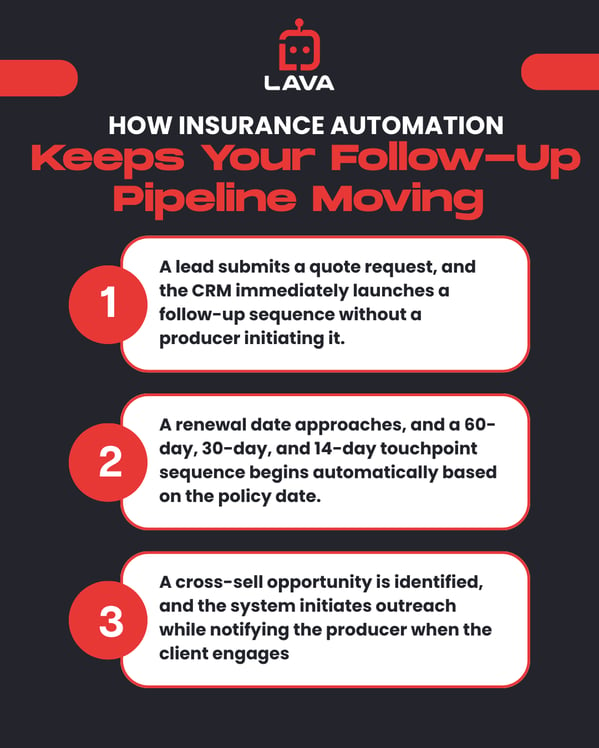
How Insurance Automation Keeps Your Follow-Up Pipeline Moving
Insurance automation removes the dependency on memory and available time by triggering follow-up sequences the moment a qualifying action occurs.
- A lead submits a quote request, and the CRM immediately launches a follow-up sequence without a producer initiating it
- A renewal date approaches, and a 60-day, 30-day, and 14-day touchpoint sequence begins automatically based on the policy date.
- A cross-sell opportunity is identified, and the system initiates outreach while notifying the producer when the client engages.
Insurance automation ensures the producer is never the reason a follow-up did not happen. The result is a pipeline that moves consistently regardless of how busy the production day is.
To understand whether your agency is structured well enough to support insurance automation, read: How Do You Know if Your Insurance Agency Is Ready for Automation?
When Manual Follow-Up Still Outperforms Automation
Insurance automation handles the volume, but it does not handle the judgment.
A client responding to a renewal reminder with a coverage question needs a producer, and a long-term client navigating a complicated claim needs a relationship.
The highest-performing agencies use insurance automation to own the scheduled, repeatable touchpoints and reserve manual follow-up for moments that require expertise and judgment.
Is your agency using producers for conversations only they can have, or for work that a system could handle just as well?
CRM Automation vs Manual Follow-Up: A Real Agency Comparison
A 12-producer independent agency managing 1,800 accounts ran all follow-up manually. Each producer maintained their own tracking system, and the results were inconsistent across the board.
Before insurance automation:
- Some clients heard from the agency 60 days before renewal. Others heard at 14 days. Some not at all.
- In one quarter, the agency lost 22 accounts to competitors
- In 17 of those cases, the departing client had not received proactive outreach before their renewal
After implementing insurance automation:
- Every client received a renewal touchpoint at 60 days, 30 days, and 14 days, regardless of which producer owned the account
- Accounts lost to non-contact dropped to zero in the following quarter
The structure changed, and the results followed.
Should Your Insurance Agency Use CRM Automation or Manual Follow-Ups
The answer depends on where your follow-up is currently breaking down.
If leads are going cold before producers can reach them, insurance automation closes that gap immediately.
If renewals are slipping because the volume is too high to track manually, automation owns the outreach schedule.
If cross-sell lists are sitting untouched, automation initiates outreach and flags engaged clients for producer follow-up.
The agencies growing their books fastest are those whose systems make sure no follow-up opportunity is ever left to chance.
CRM Automation vs Manual Follow-Up: Which Grows Your Book Faster
Manual follow-up feels more personal. Insurance automation feels more consistent. The answer to which one grows your book faster is about which one ensures every lead, renewal, and cross-sell opportunity gets the follow-up it needs at the right time.
Manual follow-up works until the book outgrows it. For most agencies, that happens earlier than expected, and the evidence shows up in leads that went cold and renewals that slipped.
Insurance automation closes those gaps without asking more of your producers. It owns the timing, so your licensed team owns the conversations.
But the real competitive advantage is not just the automation itself. It is the consistency automation creates. Every producer in your agency follows up on the same schedule, and every client receives the same quality of outreach regardless of how busy the week was. That consistency is what converts leads and compounds into book growth over time.
At Lava Automation, we build insurance automation systems inside your existing CRM and AMS, so your follow-up pipeline runs consistently regardless of how busy the production day gets. Over $4 billion in premium runs on what we have built across more than 300 agencies.
To understand how insurance automation drives growth and retention across every stage of the client relationship, read: How Insurance Agency Automation Drives Growth and Retention.
Frequently Asked Questions
What is the difference between CRM automation and manual follow-ups for insurance agencies?
Manual follow-up depends on a producer remembering to initiate each touchpoint at the right time. Insurance automation triggers follow-up sequences automatically, so no touchpoint depends on available bandwidth.
Does insurance automation replace the need for producers to follow up personally?
Insurance automation handles scheduled, repeatable touchpoints. Personal follow-up remains essential for conversations requiring judgment and relationship context.
Which insurance agencies benefit most from CRM automation?
Agencies managing high lead volume, large renewal books, or cross-sell lists that are not being consistently worked see the fastest return from insurance automation.
How quickly does insurance automation improve follow-up consistency?
Most agencies see measurable improvement within the first 30 days of implementation.
What does Lava build for insurance agency follow-up automation?
Lava builds follow-up sequences inside your existing CRM and AMS, so lead acknowledgment, renewal outreach, and cross-sell touchpoints all trigger automatically around your specific processes.
