
You have never shaken this person's hand. You have never seen their office or watched how they carry themselves in a room. And you are about to hand them access to your CRM, your client data, and a piece of your business you have spent years building.
That discomfort is normal. It is also the exact reason most business owners hesitate to hire a virtual assistant for small-business needs, even when everything about the candidate on paper looks right.
At Lava Automation, we have placed virtual assistants inside more than 300 growing businesses, and the same question comes up almost every time before the hire is finalized. How do you trust someone you have never physically met? The answer has less to do with meeting them in person.
In this article, you will learn why trusting a virtual assistant feels riskier than it actually is, what genuinely builds that trust, and the daily habits that make it happen faster than you expect.
Why Trusting a Virtual Assistant for a Small Business You Have Never Met Feels Risky
Trust has traditionally been built through physical presence. A handshake. Eye contact. Watching someone work a room or handle a difficult moment. Remove all of that, and trust suddenly feels like something you cannot verify.
This is why hiring a virtual assistant for small business operations feels different from hiring someone who walks into your office every day. The absence of familiar signals makes the relationship feel unverifiable, even when the person on the other end is entirely capable and trustworthy.
Trust with a remote hire simply looks different than the trust you are used to.
Once you know what those signals actually are, the unfamiliarity stops feeling like risk.
What Builds Trust With a Virtual Assistant for Small Business
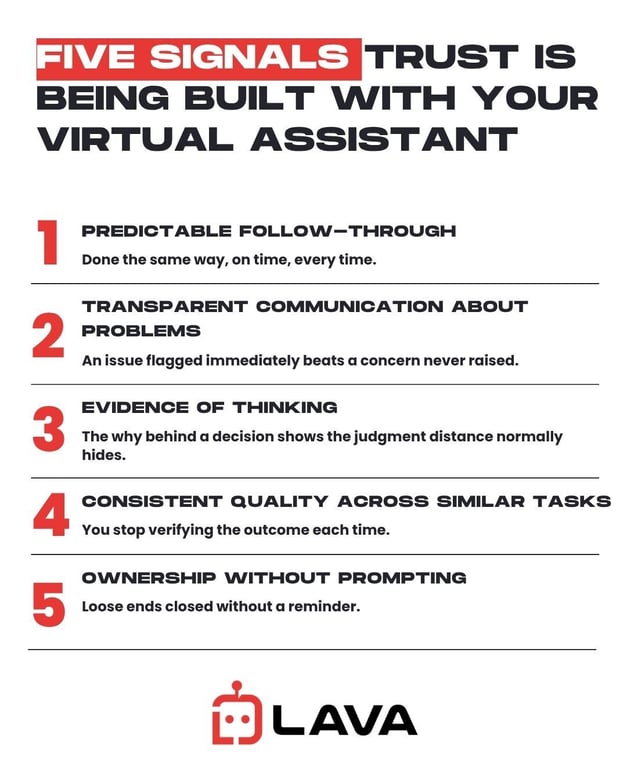
The business owners who trust their virtual assistant and have developed a successful working relationship have built a different but equally reliable set of trust signals.
Predictable follow-through
Trust compounds quickly when a task is assigned, and it gets done the same way, on time, every time.
Transparent communication about problems
A virtual assistant who flags an issue immediately instead of hiding it or guessing builds trust faster than one who never raises a concern at all.
Evidence of thinking
When your virtual assistant explains why they handled something a certain way, you get visibility into their judgment, which is exactly the thing distance normally hides.
Consistent quality across similar tasks
You stop needing to verify the outcome and start trusting the process when the same type of task produces the same level of quality every time.
Ownership without prompting
A virtual assistant who closes loose ends and does not wait to be reminded shows they are managing the work rather than just completing it.
At Lava Automation, we see these five signals show up across the businesses we work with, and we train every virtual assistant to demonstrate them from day one rather than leaving trust to develop by chance.
The Daily Habits That Build Trust With a Virtual Assistant
Trust also builds in small, repeated moments that accumulate over weeks.
- A daily or weekly check-in, even a brief one, gives you visibility without requiring you to hover.
- A shared task list that both of you can see in real time replaces the casual desk-side glance.
- Clear documentation of decisions made on your behalf means you are never surprised by something after the fact.
All of these habits require consistency maintained on both sides of the relationship.
What happens if the trust you are trying to build never gets the chance to take hold because the hire did not work out the way you expected? Read: What Happens When a Virtual Assistant Doesn't Work Out?
What Doubting Your Virtual Assistant Too Early Actually Costs You
Double-checking everything in the first few weeks feels responsible. In practice, it slows down the trust you are trying to build.
When you review every task line by line, your virtual assistant never gets the chance to prove they can work without that oversight. You also never get the time back you hired a virtual assistant to create because you are still doing the checking work yourself.
Reduce oversight as consistency shows up. Do not keep it fixed at the same level indefinitely.
The Signs Trust With Your Virtual Assistant Is Actually Building
Trust is measurable, even without meeting someone in person. A few signs indicate it is genuinely forming rather than just being assumed.
- You stop reviewing every completed task line by line and start spot-checking instead.
- Your virtual assistant starts flagging potential issues before you even ask about them.
- You catch yourself handing off a slightly more complex task than you would have a month ago, without the same hesitation you felt initially.
If none of these signs show up after a reasonable period, something in the setup or communication needs adjusting.
What Building Trust With a Remote Hire Requires
Handing meaningful work to someone you have never met in person felt like it required a level of faith you were not sure you had.
What this article has shown is that trust with a remote hire requires the same thing trust has always required, just delivered through different signals.
Predictable follow-through instead of a handshake. Transparent communication instead of watching body language. Consistent daily habits instead of a shared physical space.
Once those signals are in place, the discomfort you started with tends to resolve itself within the first several weeks, because the evidence built the trust for you.
At Lava Automation, we place virtual assistants who are trained on your specific systems and supported by our team throughout the engagement. The structure for trust is already in place before day one even begins. More than 300 businesses have gone through exactly this process.
Everything covered here- predictability, communication, ownership- gets shaped by how the relationship starts. Onboarding is where that foundation gets laid. To see exactly what onboarding looks like from the first day forward, read: What to Expect When Onboarding a Virtual Assistant for a Small Business
Frequently Asked Questions
How do you know if you can trust a virtual assistant you have never met in person?
Trust builds through consistency. Predictable follow-through, transparent communication about problems, and visibility into their decision-making process are strong trust indicators.
How long does it typically take to build trust with a virtual assistant?
Most business owners see measurable signs of trust within the first few weeks once consistent communication habits and predictable task completion are established. The exact timeline depends on task complexity and how quickly feedback loops are put in place.
What are the signs that trust is genuinely building with a remote hire?
You start spot-checking instead of reviewing every task, your virtual assistant proactively flags potential issues, and you feel comfortable handing off increasingly complex work without the hesitation you felt at the start.
