

Wondering what actually happens after you sign with Lava? Concerned that implementation will disrupt your agency for months before you see any return?
Most agency owners share both concerns before they start, but the disruption worry is the one that causes the most unnecessary delay.
The build process is structured precisely to avoid it. The right process moves quickly without skipping the mapping work that makes automation actually perform.
At Lava Automation, we have built and launched automation systems for more than 300 insurance agencies, managing over $4 billion in premiums. We know what needs to happen before a single workflow goes live and how long each phase should take.
In this article, you will see exactly what happens before your build starts, what the build timeline looks like, and what changes once automation is fully live.
What Happens Before Insurance Agency Automation Goes Live
Before any workflow gets built, Lava maps your current operation. It is a structured review of your existing AMS, CRM, and carrier communication systems to understand exactly how work currently moves through your agency.
During this phase, we identify:
- Which workflows are currently running manually, and where the gaps are costing you selling time
- How your CRM is structured and what data is already available to build automation around
- Which carrier systems need to integrate with your automation, and how those integrations currently work
- Where your renewal, cross-sell, and follow-up processes break down most often
Every agency operates differently, even when the core problems look the same. Two agencies with identical premium volume can have completely different CRM structures, different carrier relationships, and different internal processes for handling renewals and cross-sell outreach.
Lava maps your specific workflows first and builds automation that matches how your operation actually runs.
Niki Henley, an agency owner in Owasso, Oklahoma, put it directly: implementing the full system forced her to think through every single process in her agency before automating any of them, rather than automating broken processes and hoping the workflow improved on its own.
This means your automation is built around how your agency already operates:
- Your renewal reminders trigger based on your actual policy data structure
- Your lead routing follows your actual producer assignment logic
- Your CRM updates sync with the fields your team already uses, not a standardized template that requires your team to change how they work.
If you are still comparing providers, read Common Automation Mistakes That Waste Thousands of Dollars to avoid choosing a system that looks impressive in a demo but fails during implementation.
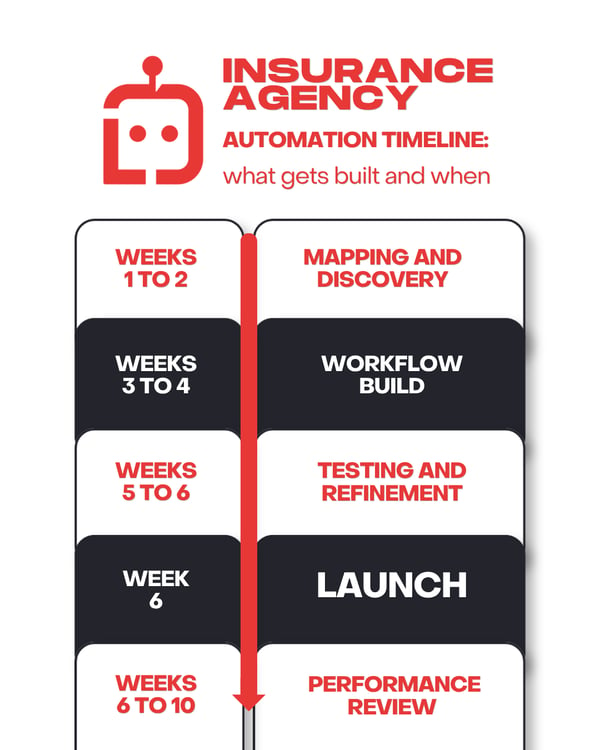
Insurance Agency Automation Timeline: What Gets Built and When
The full build typically takes 60 days from kickoff to full launch. Here is what that looked like for Ross Bennett, Vice President at Heaton and Bennett Insurance, who joined Lava mid-2021 to build a more structured, automated operation across their personal and commercial lines departments.
Weeks 1 to 2: Mapping and Discovery
Lava mapped Heaton and Bennett's existing systems and workflows, identifying where manual processes were consuming producer time and where automation would deliver the fastest return across both service lines.
Weeks 3 to 4: Workflow Build
Renewal reminders, lead routing, and follow-up sequences were built around their specific systems and producer assignment logic. Virtual assistant support was layered in alongside the automation to handle the judgment-dependent work that the workflows could not resolve.
Weeks 5 to 6: Testing and Refinement
Lava tested every workflow inside its actual tools before going live. Adjustments were made based on how the workflows performed against real data specific to their operation.
Week 6: Launch
The automation went live across both personal and commercial lines departments.
Weeks 6 to 10: Performance Review
Structured check-ins tracked performance and refined workflows based on actual results.
Result: 2022 was Heaton and Bennett's first full year with Lava in place. They doubled their new business premium that year compared to 2021 and were on track to continue that growth into 2023. In Ross Bennett's words: "Partnering with Lava has been one of the best decisions that we've made as an agency."
What Insurance Agency Automation Looks Like Once It Is Live
Once your automation is live, here is what runs without anyone managing it:
- Renewal reminders go out automatically based on policy dates
- Lead follow-up sequences trigger the moment a new inquiry comes in
- CRM updates sync without manual entry after every call
- Cross-sell campaigns run against your existing book without anyone pulling lists manually
Niki Henley's agency saw its Google review count climb from roughly 25 to 70, nearly all five-star. The reviews simply became a byproduct of the automated onboarding sequence already running in the background.
Your producers stop managing the timing of these workflows and start focusing entirely on the conversations that require their expertise.
What Building Insurance Agency Automation With Lava Actually Looks Like
You came to this article wanting to understand what implementing automation with Lava actually involves before committing. Now you have a clear picture of the timeline, the process, and what changes inside your agency once it is live.
The build starts with mapping how your agency actually operates. The workflows that get built match your systems, your processes, and your specific renewal and cross-sell logic, not a generic template adjusted slightly for insurance.
At Lava Automation, the build runs approximately 60 days from kickoff to full launch, with structured performance reviews continuing through week 10. Over $4 billion in premium runs on automation we have built across more than 300 agencies, all under one SOC 2 certified partnership.
The next step is a 30-minute demo where we map your current workflows, identify exactly where automation would deliver the fastest return inside your agency, and show you what we would build first.
Book a demo to see what we would build inside your agency.
Frequently Asked Questions
How long does it take Lava to build and launch automation inside an insurance agency?
The full build typically takes 60 days from kickoff to full launch. Mapping and discovery take the first two weeks; the workflow build takes weeks three and four; testing and refinement take weeks five and six; and structured performance reviews continue through week ten.
Will my producers need training after automation goes live?
Minimal training is required. Because automation runs within the systems your producers already use, the learning curve is limited to understanding which tasks it now owns. Lava provides documentation and check-ins through week ten to support the transition.
Can workflows change after launch?
Yes. Structured performance reviews run through week ten specifically to identify workflows that need adjustment based on real results. Lava refines workflows after launch, not just during the build.
Does the automation build require my team to change how they work?
No. Lava builds automation around your existing systems and processes, so your team works the same way they already do while the repetitive, scheduled tasks run automatically in the background.
