

Have you ever had a system fail, called the vendor responsible, and been told the problem was someone else's?
That moment costs more than the time it takes to resolve. Clients experience delays. Onboarding stalls. Revenue-producing work stops while your team waits for two vendors to agree on who owns the fix. For a growing business, that kind of operational drag compounds quickly.
At Lava Automation, we work with more than 300 growing businesses, and we see the same pattern repeat regardless of industry or team size. Outsourcing services gets pieced together one vendor at a time, and by the time the friction becomes obvious, the gaps between those vendors have already become part of how the business runs.
In this article, you will learn why outsourcing services to multiple vendors creates accountability gaps, how fragmented vendor relationships slow daily execution, and what to look for in a partner that owns outcomes rather than just deliverables.
Why Outsourcing Services to Multiple Vendors Creates Operational Gaps
Most growing businesses build their outsourced support one decision at a time. A virtual assistant placed through one provider. Automation built by another. IT managed by a third party.
Each decision made sense at the time.
The problem surfaces when something goes wrong across two of those areas at once. Here is what that looks like in practice:
- A workflow breaks because the automation is not syncing correctly with the CRM that the IT vendor manages
- Your virtual assistant cannot complete the task because access permissions were never updated after a system change
- You call the automation vendor. They point to the IT configuration. The IT vendor points back to the automation setup. The virtual assistant waits.
Fragmented vendor relationships create gaps at every handoff point, and those gaps become your responsibility.
That coordination burden falls on whoever is available, which in most growing businesses means the owner or an operations leader who already has more important work to do.
What Accountability Actually Looks Like in a Vendor Relationship
Accountability in an operational partnership means one thing: when something does not work, one partner owns the outcome without qualification.
Most outsourcing service relationships do not work this way.
Contracts define scope carefully to limit liability. Support tickets get routed between departments. By the time a resolution appears, the business has already absorbed the cost of the delay.
Real accountability means the partner who built the system is also the one responsible for fixing it, maintaining it, and improving it over time.
When something breaks, there is no finger-pointing and no waiting for two vendors to agree on whose problem it is. One partner owns it from the moment something goes wrong to the moment it is resolved.
How a Single Partner Changes Daily Execution
Accountability matters most when something breaks. But the value of a single partner shows up every day, whether there is an incident or not.
With multiple vendors, routine changes require multiple conversations. Adding a new team member means updating access with the IT vendor, adjusting workflow ownership with the automation provider, and briefing the virtual assistant separately. Each step involves a different contact and timeline.
With a single partner, that same change moves through one conversation. The workflow adjustment and the team briefing happen inside one relationship with one point of accountability.
Over time, that consistency compounds. The partner managing your automation also understands your staffing. The team overseeing your IT also knows your workflows.
Decisions get made with the full picture rather than a partial one, and the business runs with less friction.
To see how agencies are using this approach to stay ahead, read: How Agencies Stay Competitive with Automation and Virtual Assistants
What to Look for When Consolidating Outsourced Services
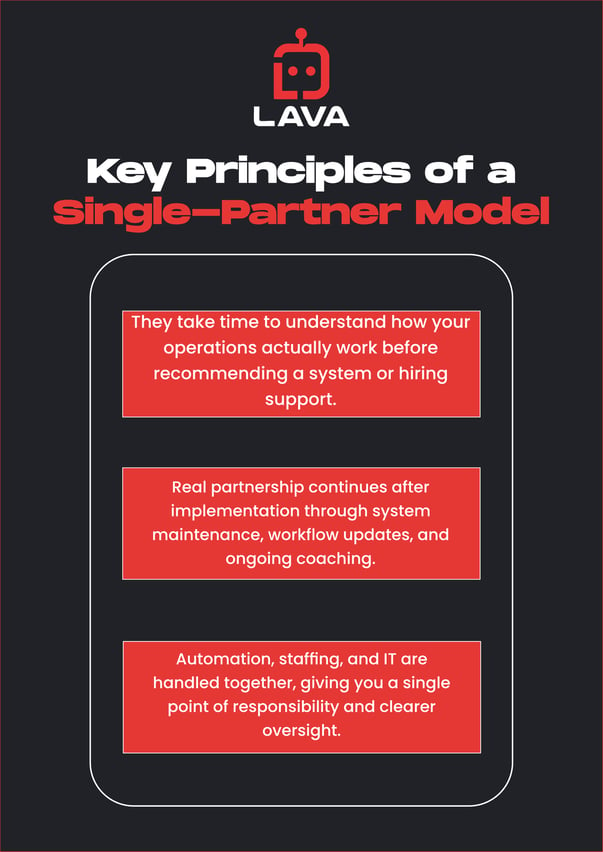
A genuine single-partner model includes a few specific characteristics:
- The partner diagnoses before they build, meaning they want to understand how your operation actually runs before recommending a system or placing a hire.
- The partner stays involved after delivery, because maintaining a system and coaching a virtual assistant as workflows evolve is where real partnership happens.
- The partner manages your automation, staffing, and IT under one accountability structure, so there is one point of responsibility.
The right partner is more invested in whether the outcome works than in whether the deliverable was completed.
Accountability is harder to maintain when outsourcing services are split across separate providers with separate security standards.
At Lava Automation, our model is built around exactly this. Automation, virtual assistants, and IT infrastructure working together under one partnership, designed to build the operational foundation that allows businesses to scale.
Why Outsourcing Services to One Partner Is a Growth Decision
Every vendor relationship you maintain requires time, oversight, and coordination. As the business scales, that coordination cost grows with it.
A single operational partner reduces outsourcing services overhead and gives leadership time back to focus on growth instead of coordination.
If your team is absorbing coordination work that a structured partner should own, or if a lack of clear accountability has already cost you time or revenue, that is the gap worth addressing before it compounds further.
At Lava Automation, we manage automation, virtual assistants, and IT infrastructure under one partnership with one team accountable for the outcome. When something is not working, we own the fix. When your business changes, we adjust the system. When growth creates new operational demands, we are already inside the operation.
If you want to see what it looks like when a single provider manages your automation, staffing, and IT as one integrated system, read: Why Insurance Agencies Use Virtual Assistants with Automation.
Frequently Asked Questions
What is the problem with outsourcing services to multiple vendors?
Each vendor manages only their piece of the operation. The gaps between where one provider's scope ends and another's begins create handoff points that nobody actively monitors.
What should a single partner be responsible for?
Automation, virtual assistant support, and IT and security management under one accountable relationship. The goal is one partner who owns the outcome across all three areas.
How do you know if your current vendor structure is creating problems?
If your team is regularly coordinating between vendors to resolve issues, if routine changes require multiple conversations, or if nobody can clearly answer who owns a specific outcome, your current structure has accountability gaps.
When might separate vendors be a better fit?
If your business requires deep specialization in a narrow technical area, a dedicated specialist may outperform a generalist partner in that domain. The tradeoff is the coordination burden that comes with managing multiple vendor relationships.
How is Lava Automation different from a typical provider?
Lava manages automation, virtual assistants, and IT infrastructure as one integrated solution. One team owns the outcome across all three areas. It is a partner that understands the full picture of how your business operates.
