

Do you find yourself managing IT vendors, troubleshooting technology issues, and worrying about security on top of everything else running your business requires?
Have you considered bringing in outside IT support, but are not sure what that actually means or whether it is worth the investment?
Most growing businesses reach a point where technology becomes harder to manage than the work it was supposed to support. Systems go unmonitored. Devices fall behind on updates. Security gaps accumulate quietly until something goes wrong.
And the person responsible for fixing it is usually the business owner or whoever is available.
At Lava Automation, we manage IT and security infrastructure for more than 300 growing businesses. The pattern we consistently see is a business that has outgrown its informal approach to managing itself.
In this article, you will learn exactly what a managed IT provider does for your business, how it differs from the IT support you may already have, and why it becomes critical as your business grows.
What Is a Managed IT Provider?
A managed IT provider takes continuous full ownership of your technology infrastructure.
The difference between a managed IT provider and traditional IT support is the difference between prevention and reaction.
Traditional IT support, often called break-fix, responds when something goes wrong. You call, they fix it, you pay for the time.
The problem with that model is that by the time you call, the damage is already happening. A breach is already inside your systems, or a device failure has already disrupted your team.
A managed IT provider monitors your environment continuously and owns the outcome of your technology infrastructure around the clock. They call you even before something breaks.
What Does a Managed IT Provider Actually Do Day to Day?
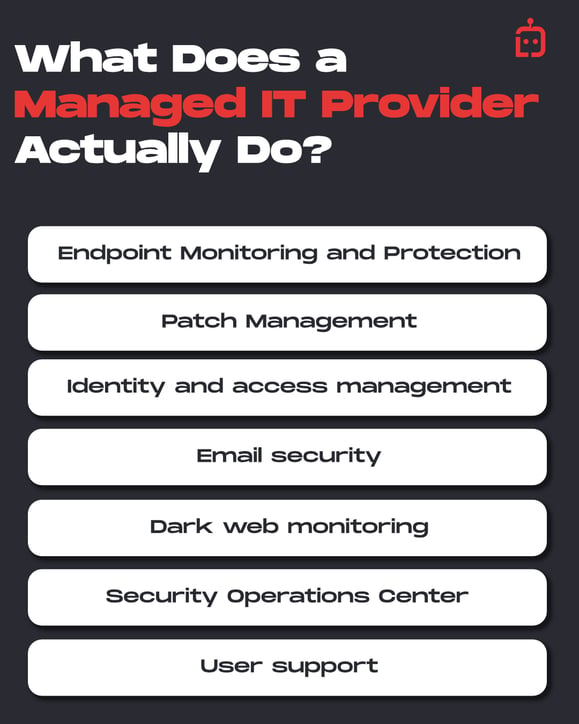
This is where most business owners have the least visibility. The work a managed IT provider does is largely invisible when it is working correctly. Here is what that work actually includes.
- Endpoint monitoring and protection
Every device connected to your network is being watched in real time. Unusual behavior, unauthorized access attempts, and malware are detected and responded to the moment they appear.
- Patch management
This ensures that every device and application in your environment is running the latest software. Most successful cyberattacks exploit known vulnerabilities in outdated software. Consistent patching closes those gaps.
- Identity and access management
Every user has permissions aligned with their role. When someone joins your team, access is provisioned correctly from day one. When someone leaves, it is removed immediately.
- Email security
Phishing attempts, impersonation attacks, and data exfiltration attempts are blocked at the source rather than relying on your team to recognize them.
- Dark web monitoring
This continuously scans breach databases and alerts you when your credentials appear in places where they shouldn't.
- Security Operations Center monitoring
Provides around-the-clock oversight of your environment with real-time alert review and immediate escalation of genuine threats. It is active, continuous surveillance.
- User support
Your team has a direct line to IT help when they need it. We work when you work, five days a week, so devices, access issues, software problems, and connectivity questions are handled quickly.
At Lava Automation, we apply these same security and management practices across every client environment, with continuous monitoring, structured access control, and real-time response built into daily operations.
To see how Lava applies these security practices inside real business environments, read: How Lava Automation Protects Insurance Agency Data.
Why Do Growing Businesses Need Managed IT Support?
A small team running on familiar tools can manage IT informally. Everyone knows the passwords. The systems are simple. Problems are rare and can be fixed with minimal overhead.
As the business grows, that approach stops working.
More employees mean more devices and more access points for something to go wrong. More clients mean more sensitive data sitting inside your infrastructure, and more exposure if any of it is compromised.
The informal IT habits that worked for five employees create serious exposure at twenty-five.
Growing businesses consistently underestimate this transition until they experience a breach or a compliance review that reveals how exposed they actually were.
At that point, the cost of addressing the problem reactively far exceeds what proactive management would have cost.
What Is the Difference Between Having IT Tools and Having IT Management?
Most businesses already have some security tools in place. Antivirus software. A firewall. Maybe a password manager. But the truth is, tools without management are just the appearance of security.
The presence of those tools creates a false sense of security that is more dangerous than having nothing at all.
A managed IT provider deploys tools, but it doesn’t stop there. They configure them correctly, monitor them continuously, update them consistently, and respond when they flag something.
That is the difference between having a tool and having a system that works.
When Is the Right Time to Invest in Managed IT for Your Business?
If your business is growing and your technology is managed informally, the gap between where you are and where you need to be is widening every month.
The businesses that avoid costly breaches and outages are the ones that stopped treating technology as something to deal with when it breaks and started treating it as infrastructure that requires consistent ownership.
A managed IT provider removes complexity from your business. One partner owns your full technology environment, so you never have to wonder whether your systems are protected or your team is supported.
At Lava Automation, we manage your full IT and security infrastructure for $150 per seat per month. Endpoint protection, email security, dark web monitoring, identity and access management, Security Operations Center monitoring, and 24x5 user support. One partner. One flat rate.
Want to see how Lava's security infrastructure works in practice? Watch the Lava Automation Security overview.
Frequently Asked Questions
What is the difference between a managed IT provider and break-fix IT support?
Break-fix support responds after something goes wrong. A managed IT provider continuously monitors your environment and addresses problems before they escalate into incidents.
Do I need a managed IT provider if I already have security tools in place?
Having tools is not the same as having management. Tools that are not properly configured and not updated regularly create a false sense of security. A managed IT provider ensures that every tool in your environment is working as it should.
How does a managed IT provider handle a security incident?
A managed provider monitors your environment in real time. When a threat is detected, it is mitigated quickly, and the root cause is investigated fully. Your team is notified, and the threat is contained before it can spread.
What size business benefits most from managed IT?
Any business handling sensitive client data, running on multiple systems, or growing beyond informal IT management benefits from a managed provider. Size matters less than complexity and the volume of data your business is responsible for protecting.
What does Lava's managed IT service include?
Endpoint protection, email security, dark web monitoring, identity and access management, Security Operations Center monitoring, and 24x5 user support. All of it is managed by a single partner at a flat rate of $150 per seat per month.
