

Do you assume a data breach is something your business would recover from quickly?
What would actually happen if an attacker had been inside your systems for weeks and your client data was already exposed before you knew anything was wrong?
Most small business owners do not realize that a breach can go undetected for months. Attackers want your business to keep running while they quietly extract data. By the time you notice something is wrong, the damage is already significant.
At Lava Automation, we have managed IT and security infrastructure for growing businesses across service-based industries. We have seen firsthand how badly a breach escalates when there is no structured protection in place before something goes wrong.
In this article, you will learn exactly what happens to a small business after a data breach, why the damage compounds over time, and what structured protection actually prevents.
What Happens When a Breach Is Discovered?
For many small businesses, a breach is not discovered in real time. It surfaces days, weeks, or sometimes months after the attacker first gained access. By then, the question compounds to how long it has been happening and how much was taken.
Once a breach is confirmed, systems may need to be taken offline to prevent further access. Work stops. Employees cannot access the tools they need. Client-facing operations slow or halt entirely.
The business owner is simultaneously trying to understand the scope of the breach, who to call, and how to communicate with clients who are already noticing something is wrong.
For a small business without a managed IT partner, this phase is handled by whoever is available. That is usually the business owner, a general IT vendor who has never dealt with an active incident, or nobody at all. Every hour without a coordinated response compounds the damage.
What Are the Direct Financial Costs of a Data Breach?
The average cost of a cybersecurity incident for a small or mid-sized business exceeds $200,000, according to industry research from IBM and the Ponemon Institute.
A breach typically includes:
- Forensic investigation to determine how the attacker got in and what was accessed.
- System recovery to rebuild or replace compromised infrastructure
- Legal and compliance costs, including mandatory breach notification and potential regulatory fines
- Client notification expenses are required by law once personal data is confirmed as compromised
To put this in context, a business paying $150 per seat per month for fully managed IT would spend approximately $1,800 per year per employee on prevention.
What Happens to Client Trust After a Breach?
The financial cost of a breach is quantifiable. What happens to your client relationships is harder to measure and often more damaging in the long run.
The clients who trusted you with their sensitive data now have to be told that information may have been compromised. How that conversation goes depends entirely on how quickly you respond and how honestly you communicate.
Most clients who leave after a breach leave because of how the business handled it.
A slow or vague response signals that their data was not a priority. For many small businesses, the relationships lost in the aftermath represent a permanent reduction in revenue. Those clients do not easily come back.
What Are the Operational Consequences That Last Beyond the Incident?
The breach ends when the attacker is removed, but the consequences do not.
The disruption only truly ends when the business has rebuilt the trust, the processes, and the infrastructure that the breach exposed as inadequate.
That rebuilding happens while you are still trying to serve clients and recover financially:
- Systems rebuilt or replaced from the ground up
- Security protocols redesigned and documented from scratch
- Staff retrained on new procedures and access controls
- Client communication needs to be managed carefully to limit further trust erosion
- Compliance obligations are met on a timeline that does not pause for recovery
For many small businesses, this takes six to twelve months. For some, it never fully completes.
The businesses that close do so because the combination of financial cost, lost clients, and operational disruption exceeds what they can absorb.
What Would Have Prevented A Breach?
Most data breaches affecting small businesses exploit vulnerabilities that structured IT management would have closed before they were used.
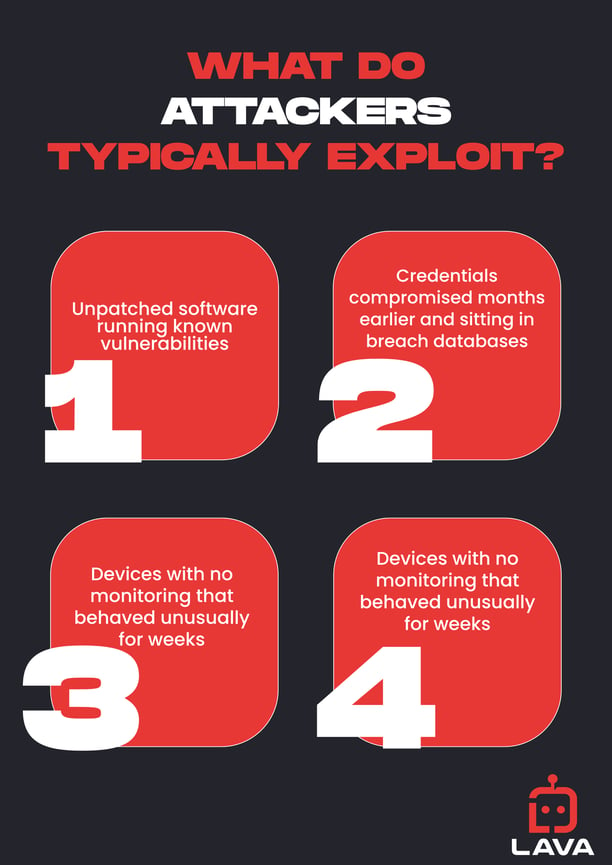
Here is what attackers typically exploit:
- Unpatched software running known vulnerabilities
- Credentials compromised months earlier and sitting in breach databases
- Devices with no monitoring that behaved unusually for weeks
- Employees who clicked phishing emails due to a lack of routine phishing training and email filtering
These are opportunistic attacks that succeed because the target was unprotected.
A managed IT provider closes these gaps before they become entry points.
Continuous endpoint monitoring detects unusual behavior in real time. Consistent patch management eliminates known vulnerabilities on schedule. Dark web monitoring catches compromised credentials before they are used. Email security stops phishing attempts before they reach your team. Security awareness training ensures your team knows how to recognize and report threats. A Security Operations Center watches your environment around the clock.
To understand what each of these practices looks like inside a fully managed system, read: What Does a Managed IT Provider Do for My Business?
Is Your Small Business Protected Against a Data Breach?
You now understand what a breach actually costs, how it unfolds, and why the damage compounds long after the incident is contained.
A data breach rarely announces itself. It arrives when a vulnerability that has been accumulating quietly reaches the point where someone decides to use it. By then, the cost of prevention has already exceeded the cost of recovery.
The businesses that avoid this outcome treat security as infrastructure requiring consistent ownership before anything goes wrong.
If you are unsure whether your current security posture would hold under pressure, that uncertainty is itself the answer. Your next step is understanding exactly where your environment is exposed.
At Lava Automation, we manage your full IT and security infrastructure for $150 per seat per month. Endpoint protection, email security, dark web monitoring, identity and access management, Security Operations Center monitoring, and 24x5 user support. One partner. One flat rate.
Book a demo with Lava Automation to walk through your current environment and understand exactly where your business is exposed before something forces the conversation.
Frequently Asked Questions
How much does a data breach cost a small business?
The average cost exceeds $200,000 according to IBM and Ponemon Institute research, covering forensic investigation, system recovery, legal fees, regulatory penalties, and client notification.
What data do attackers target in small business breaches?
Client personal information, financial records, login credentials, and internal communications are the most common targets, often held across multiple systems with inconsistent access controls.
What is the most common way small businesses get breached?
Phishing emails, compromised credentials, and unpatched software vulnerabilities are the three most common entry points.
How does a managed IT provider prevent a data breach?
By closing the vulnerabilities that attackers exploit before they are used. Continuous monitoring, consistent patching, email security, dark web monitoring, and around-the-clock Security Operations Center oversight eliminate the gaps that most small business breaches rely on.
