
At some point in every growing Farmers agency, the licensed team stops having enough hours. Renewal preparation, certificate requests, CRM updates, and follow-up sequences start consuming the same time that used to go toward prospecting and closing. The book is growing, but the selling activity that drove that growth is quietly shrinking.
The instinct when this happens is to hire another licensed staff member. That hire makes sense only when the work that needs an owner actually requires a license. Most of the time, it does not.
At Lava Automation, we have placed trained virtual assistants inside more than 300 insurance agencies managing over $4 billion in premium. The difference in cost and return between hiring licensed staff first and hiring a virtual assistant for insurance agents first is significant.
In this article, you will learn what the cost difference actually looks like, which tasks a virtual assistant for insurance agents can own completely, when licensed staff is genuinely the right next hire, and how Farmers agents decide which hire comes first.
Why Farmers Agencies Default to Hiring Licensed Staff When the Book Grows
When the agency feels stretched, the instinct is to hire another licensed staff member.
The problem is that the work slowing your team down, like renewal preparation, certificate processing, CRM updates, and follow-up sequences, does not require a license.
Paying licensed rates for that work compounds the problem instead of solving it.
Every hour a licensed producer spends on administrative work is an hour they are not closing policies and growing their book.
What a Virtual Assistant for Insurance Agents Actually Costs Versus a Licensed Hire
A licensed CSR or producer in a US-based Farmers agency typically costs $60,000 to $85,000 fully loaded annually, including salary, benefits, payroll taxes, and workers' compensation.
A virtual assistant for insurance agents from a provider like Lava runs $14 to $15 per hour with no payroll taxes, workers' compensation, or benefits overhead. Full-time, that is approximately $29,000 to $31,000 per year, less than half the fully loaded cost of a licensed hire.
The question worth asking is whether the work that needs an owner actually requires a license.
What a Virtual Assistant for Insurance Agents Handles That Licensed Staff Should Not
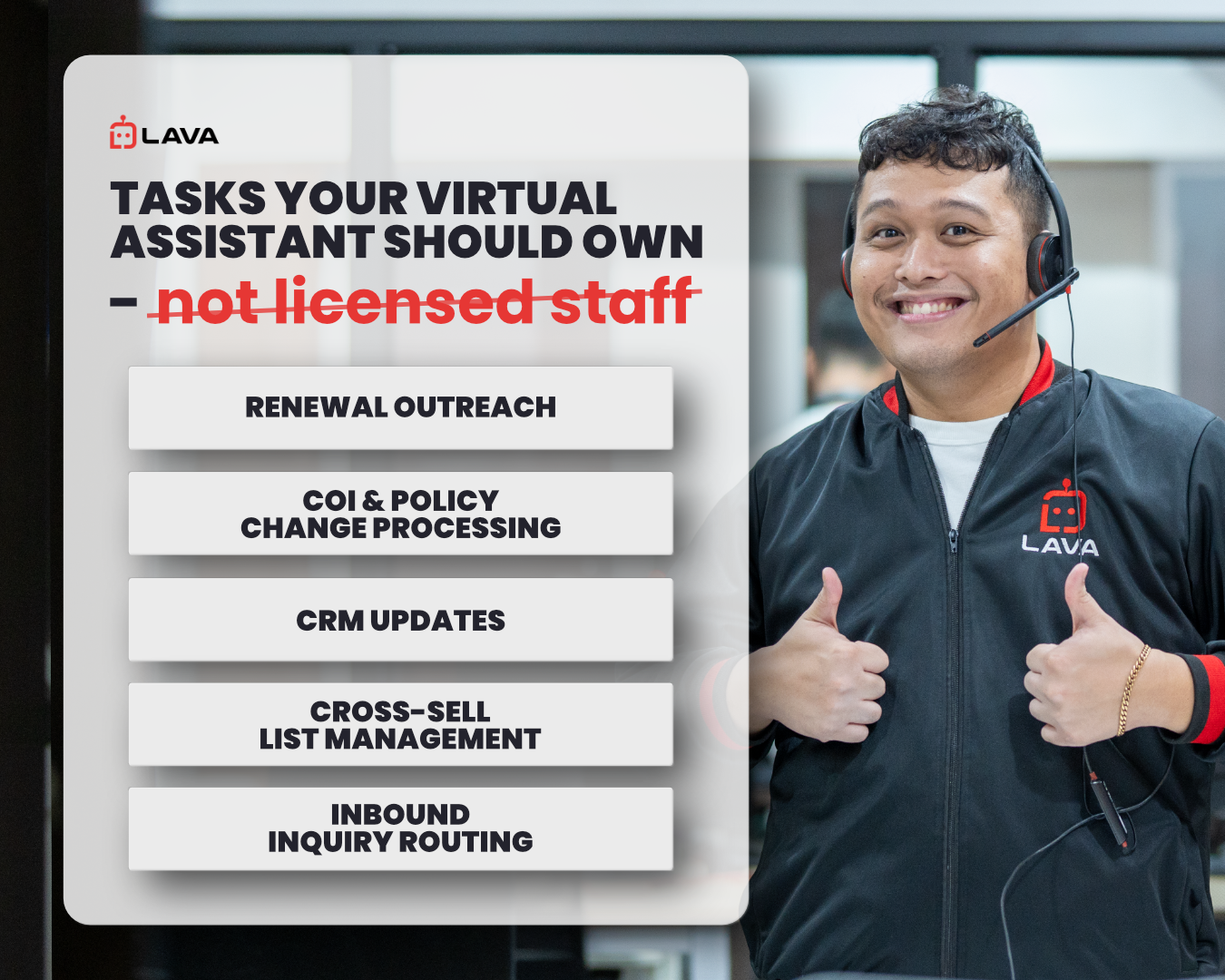
Inside a Farmers agency, your virtual assistant handles:
1. Renewal Outreach
Every client hears from your agency before their renewal date without a producer initiating it.
2. Certificate of Insurance and Policy Change Processing
Service requests move without touching a producer's calendar. Your virtual assistant processes the request and verifies accuracy.
3. CRM Updates
Every call, quote, and client interaction is logged accurately so your pipeline data stays current without manual entry.
4. Cross-Sell List Management
Single-line clients receive consistent outreach without a producer pulling lists or scheduling individual touches.
5. Inbound Inquiry Routing
Client requests reach the right person without landing in a producer's personal queue.
When a virtual assistant for insurance agents owns these tasks, your licensed professionals can focus on coverage decisions and relationships that require judgment.
Before placing a virtual assistant, most Farmers agents want to know what separates one provider from another and which questions actually matter during the evaluation. Getting that wrong means losing the time savings the hire was supposed to create.
To understand exactly what to ask before committing to a provider, read: What Questions Should I Ask Before Hiring a Virtual Assistant Company?
How Farmers Agents Structure the Hire to Protect Selling Time From Day One
Before the virtual assistant starts, each workflow needs a clear owner and a defined process so the virtual assistant can execute consistently.
The workflows worth documenting include:
- Renewal outreach and follow-up sequences
- Certificate of insurance processing and policy change requests
- CRM updates after quotes and client interactions
- Cross-sell list management and outreach
- Inbound inquiry routing
A virtual assistant for insurance agents performs at their highest when the division of responsibility is clear before they start.
When Hiring Licensed Staff First Makes More Sense
A virtual assistant for insurance agents is the right first hire for most growing Farmers agencies, but not everyone.
If your agency is already receiving more licensed conversations and compliance-sensitive client interactions than your current team can handle, hiring a licensed professional is the way to address the actual bottleneck. A virtual assistant cannot cover licensed work.
The decision comes down to an honest assessment of where the hours are going.
If licensed producers are losing time to administrative work, a virtual assistant addresses that. If they are losing selling time to licensed conversations they cannot get to fast enough, a licensed hire is the right answer.
Why the First Hire Your Farmers Agency Makes Should Be a Virtual Assistant
You came into this article because your licensed team was stretched, and the default answer, hire more staff, did not feel quite right. And somewhere in that uncertainty, the question of whether the problem was people or process never got a clear answer.
Now it does. The work consuming your licensed team's time requires a dedicated owner. A virtual assistant for insurance agents takes that work off their plate at a fraction of the cost of a licensed hire, returning those hours to activities that actually sell the business.
When the book grows enough that licensed conversations become the bottleneck, that is when a licensed hire becomes the right next move. Until then, the highest-return hire your Farmers agency can make is the one that protects your selling time.
At Lava Automation, every virtual assistant is drawn from the top 1% of more than 4,000 monthly applicants, trained on insurance workflows, and onboarded into your specific systems before handling their first task.
To see exactly what a Lava virtual assistant handles inside an insurance agency operation, read: What Can a Virtual Assistant from Lava Automation Do?
Frequently Asked Questions
Why should a Farmers agent hire a virtual assistant for insurance agents before adding licensed staff?
A virtual assistant takes ownership of the administrative and service work currently consuming your licensed producers' time. Hiring a virtual assistant first protects your licensed team's selling hours and delivers a faster return than adding another licensed hire at full cost.
What does a virtual assistant for insurance agents cost compared to a licensed staff member?
A Lava virtual assistant runs $14 to $15 per hour with no payroll taxes or benefits overhead, approximately $29,000 to $31,000 per year full-time. A licensed CSR or producer typically costs $60,000 to $85,000 fully loaded annually.
What tasks should a virtual assistant for insurance agents own inside a Farmers agency?
Renewal outreach, certificate processing, CRM updates, cross-sell list management, and inbound inquiry routing. These tasks are repeatable, do not require a license, and are currently consuming licensed producers' time.
When does hiring licensed staff make more sense than a virtual assistant for insurance agents?
When licensed conversations, coverage decisions, and compliance-sensitive client interactions are the actual bottleneck. A virtual assistant handles everything that does not require a license, so your licensed team can focus on the work that does.
