
Most businesses start delivering a great client experience by doing everything manually. Every follow-up is personal. Every touchpoint is intentional. That works at a certain size.
As the client base grows, that model breaks down. The follow-up that used to go out within 24 hours is starting to slip. The client experience declines because the volume of interactions outpaces the team's capacity to deliver them.
Six years of building automation systems have taught Lava one thing consistently. The client experience breaks down because the manual processes that worked at a smaller scale were never designed to absorb the volume that comes with growth.
In this article, you will learn why personalized client experiences break down as businesses scale, how automation restores consistency across every touchpoint, and what the client journey looks like when the right workflows are running behind it.
Why Personalized Client Experiences Are Hard to Scale Without Automation
A business with 50 clients can deliver a consistent experience through manual effort, but a business with 500 cannot. The same team, the same hours, and the same manual processes become a liability as volume grows:
- Touchpoints get missed
- Response times slow
- Clients who used to feel prioritized start feeling like a number
Without a system that owns the execution of client touchpoints, the experience degrades as the business grows.
An agent managing 400 clients cannot manually track 30 renewal touchpoints a week alongside inbound service requests and cross-sell outreach.
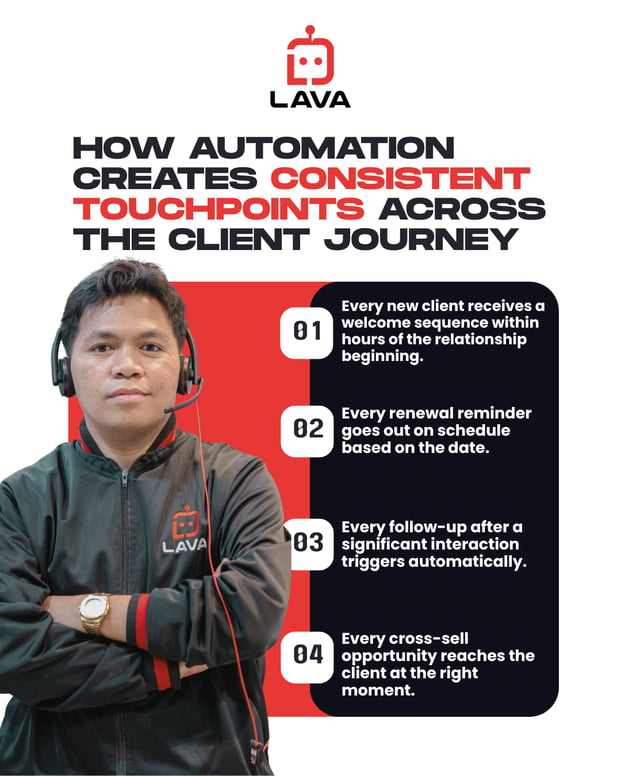
How Automation Creates Consistent Touchpoints Across the Client Journey
Every client journey has predictable touchpoints. The welcome after a new relationship begins. The reminder before an important deadline. The follow-up after a significant interaction. These are known in advance, and their execution does not require judgment.
When automation handles these touchpoints:
- Every new client receives a welcome sequence within hours of the relationship beginning
- Every renewal reminder goes out on schedule based on the date
- Every follow-up after a significant interaction triggers automatically
- Every cross-sell opportunity reaches the client at the right moment
From the client's perspective, each point simply arrives at the right time with the right message.
Where Automation Has the Biggest Impact on Client Experience
The highest-impact areas share one characteristic: they are time-sensitive, high-volume, and currently dependent on someone remembering to initiate them.
1. Onboarding sequences
These set the tone for everything that follows. An automated onboarding sequence that delivers the right information at the right intervals makes the client feel guided without requiring manual effort after the relationship begins.
2. Renewal and retention touchpoints
This is where most businesses quietly lose clients. A client who does not hear from your business before a renewal date has time to shop elsewhere.
3. Post-interaction follow-ups
These capture referral and cross-sell opportunities that most businesses know exist but rarely act on consistently. An automated follow-up within 24 to 48 hours of a positive experience captures the moment before it fades.
Businesses that automate these three areas first see the fastest improvements in client retention, referral rates, and revenue from existing relationships.
To understand whether your current workflows are structured well enough to support this kind of automation, read: How Do You Know if Your Insurance Agency Is Ready for Automation?
What Personalized Automation Looks Like Inside a Growing Business
Personalized automation means every client receives the right message at the right point in their specific journey based on where they are in the relationship.
Here is what that looks like:
- A renewal reminder goes out 60 days before the policy expiration date
- A cross-sell sequence triggers when a client adds a new line of coverage
- A post-interaction follow-up goes out three days after a claim is resolved
- A milestone check-in arrives on a contract anniversary date, without an account manager remembering to send it
The personalization comes from the data the system already has. The automation applies that data at scale, so every client receives a relevant, timely touchpoint without anyone manually initiating each one.
At Lava Automation, we build these workflows inside the CRM and communication systems your business already uses. The sequences are configured around your specific client journey, so the automation runs in the background while your team stays focused on the conversations that require them.
How to Know When Your Business Is Ready to Automate the Client Experience
Most businesses are ready to automate before they realize it.
The clearest signal is when you can identify touchpoints that are not occurring consistently because your team lacks the bandwidth to initiate them manually.
If renewal reminders are supposed to go out 60 days before expiration, and sometimes they go out 30 days before, and sometimes not at all, that is a workflow automation issue.
The starting point is identifying the three to five highest-volume touchpoints that are currently inconsistent and building automation around those first.
What Consistent Client Experiences Actually Cost Without Automation
Scaling a business exposes the limits of manual processes faster than most teams expect. The touchpoints that worked when the client list was small start slipping when the volume doubles, and the cost of that inconsistency is specific.
Every missed renewal reminder creates an opening for a client to shop with a competitor. Every delayed follow-up reduces the likelihood that a referral gets made. Every inconsistent onboarding experience increases the chance that a new client will disengage before trust is established.
These gaps show up in retention rates, referral volume, and revenue that existing relationships were already capable of producing.
For businesses that have identified these gaps, the challenge is to create a system that ensures those touchpoints occur every time, regardless of how busy the team is or how large the client list has grown.
At Lava Automation, we have seen this transformation play out across more than 300 growing businesses. We build automation workflows inside your existing CRM and communication systems, so onboarding sequences, renewal reminders, and follow-up touchpoints run consistently without your team having to manage execution. More than 300 businesses and $4 billion in premium run on what we have built.
The businesses that see the greatest return from automation are capturing more value from the relationships they already have. To see how automation drives that return, read: How Insurance Agency Automation Improves Marketing ROI
Frequently Asked Questions
How does automation create a personalized client experience at scale?
Automation applies the data your business already has about each client to deliver relevant, timely touchpoints at every stage of the relationship without requiring manual effort each time.
What client touchpoints should be automated first?
Onboarding sequences, renewal reminders, and post-interaction follow-ups deliver the fastest return. These are time-sensitive, high-volume, and currently dependent on someone manually initiating them.
Does automation make the client experience feel less personal?
Clients experience consistency. A follow-up that arrives at the right time with a relevant message feels more personal than one that arrives late because someone was too busy to send it.
How does Lava build automation for client experience?
Lava builds automation workflows within your existing CRM and communication systems, so onboarding sequences, renewal reminders, and follow-up touchpoints run automatically without your team having to manage execution.
Topics:
