

Somewhere inside your existing book of business, there is a client who added a new vehicle six weeks ago and never got asked about updating their policy.
Another client who just closed on a home and has no idea an umbrella policy would cost them almost nothing given what they already carry. Neither of these conversations happened because nobody had the bandwidth to notice the moment.
This is the predictable result of producers stretched across claims, renewals, service calls, and new business, with cross-sell conversations getting pushed to whenever there is time. That time rarely comes.
At Lava Automation, we have built insurance automation systems inside more than 300 agencies managing over $4 billion in premium. The agencies capturing the most cross-sell revenue built a system that catches the moment automatically instead of relying on a producer to notice it manually.
In this article, you will learn why cross-sell opportunities almost never happen on their own, how insurance automation finds them, the five steps behind every automated cross-sell opportunity, and what changes for your producers once this work has a different owner.
Why Cross-Sell Opportunities Rarely Happen
Cross-selling sounds simple in theory. A client already trusts your agency, already has coverage in place, and likely has a gap somewhere worth addressing. In practice, most agencies struggle to make it happen consistently.
Producer time is the first obstacle. Between service calls, claims, renewals, and new business, there is rarely a quiet moment to review a client's full policy picture and identify what else they might need.
Disconnected systems compound the problem. Client information lives across the AMS, the CRM, email threads, and phone notes, with no single place showing the complete picture. Spotting a coverage gap requires someone to manually piece that picture together.
Timing makes it worse. A client who just bought a home has a narrow window where an umbrella policy conversation makes obvious sense. If nobody notices that window while it is open, the opportunity closes quietly and does not come back.
A cross-sell opportunity that depends entirely on a producer noticing it manually will always underperform the opportunities your book contains.
How Insurance Automation Finds Cross-Sell Opportunities
Insurance automation is a system built inside your current AMS and CRM that watches client data continuously. It takes action the moment a defined trigger occurs, without waiting for a producer to notice it manually.
For cross-sell specifically, that means the system tracks every client's coverage and life events against a set of known signals:
- A client adding a new vehicle
- A client purchasing a home
- A client reaching a life stage where additional liability coverage makes sense
Each of these becomes an automatic trigger.
The system checks existing coverage against common gaps: a client with auto and home but no umbrella, or a landlord with rental properties but no landlord protection. Then, it surfaces the match.
Once a match is found, it can flag the opportunity, notify the producer, or launch outreach directly to the client.
This works at the scale of your business simultaneously. Every client gets the same consistent monitoring regardless of which producer manages their account or how busy that producer happens to be that week.
To understand exactly where insurance process automation delivers the fastest return across different parts of an agency, read: Where Insurance Process Automation Makes the Biggest Impact.
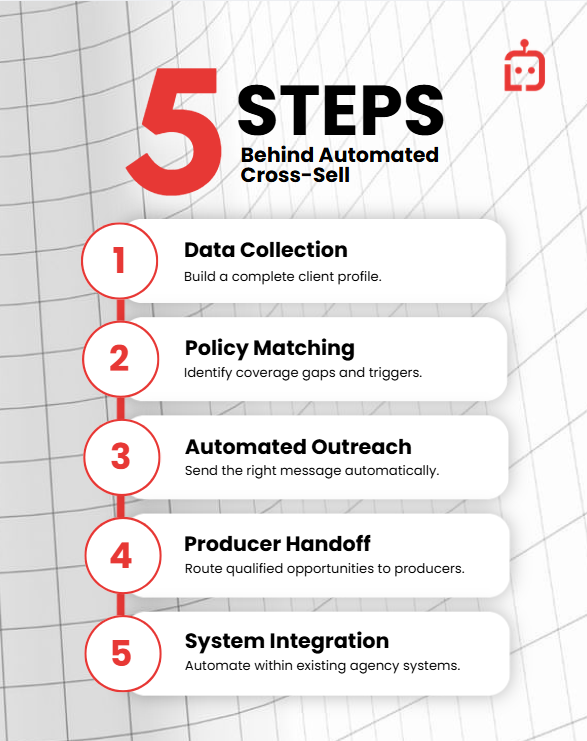
The Five Steps Behind Every Automated Cross-Sell Opportunity
Cross-sell automation is a sequence of steps that runs consistently in the background of a well-built system.
1. Data collection. Every client interaction, policy update, and quote request feeds into a continuously updated client profile pulled from the AMS, CRM, and other systems the agency already uses.
2. Policy matching. The system checks each client's profile against common coverage gaps and life events, flagging matches like a newly married couple or a client with no umbrella policy.
3. Automated outreach. Once a match is identified, communication goes out automatically: an email explaining the coverage gap or a task assigned to the producer to follow up directly.
4. Producer handoff. When a client responds or reaches a decision point, the conversation routes to the producer with full context already attached, so they step in as the trusted advisor at the right moment.
5. System integration. All of this runs inside the tools the agency already uses. The existing AMS and CRM do more of the work automatically.
What Changes for Producers Once Insurance Automation Owns This
Before automation, cross-sell conversations depended entirely on a producer remembering to have them, usually squeezed in between higher-priority tasks.
Once insurance automation owns the identification and initial outreach:
- Producers step into conversations that are already warm
- The client has already received an email or text explaining why the coverage gap matters
- The producer's job shifts from noticing the opportunity to closing it, which is the part of the job that actually requires their license and expertise
Agencies working with Lava reclaim 15 to 20 staff hours every week once this kind of automation is running, hours that were previously spent trying to manually track cross-sell opportunities across an entire book of business.
The Revenue Already Sitting Inside Your Existing Book
You came into this article because your agency likely has more cross-sell potential than your current process is capturing. That gap is the predictable result of a manual process trying to track opportunities at a scale no person can realistically manage alone.
The revenue sitting inside your existing book just requires a system that notices what a producer cannot notice manually, at the exact moment the opportunity is open.
At Lava Automation, we build insurance automation systems that identify cross-sell opportunities automatically and route them to your producers with the context they need to close the conversation. Over $4 billion in premium runs on what we have built across more than 300 agencies.
To see exactly what this looks like inside a real agency six months after implementation, read: What Your Agency Looks Like Six Months After Automating With Lava.
Frequently Asked Questions
Why do insurance agencies struggle to cross-sell consistently?
Producer time is limited, client data lives across disconnected systems, and cross-sell windows close fast after a life event. Without automation, catching these moments depends entirely on a producer noticing them manually.
How does insurance automation identify cross-sell opportunities?
It monitors client data for specific triggers, like a new vehicle, a home purchase, or a coverage gap such as auto and home without umbrella, and surfaces the match automatically.
What happens after insurance automation identifies a cross-sell opportunity?
Automated outreach goes out first: an email or text explaining the gap. Once the client responds, the conversation routes to the producer, fully informed and ready to close it.
Does cross-sell automation replace the producer's role?
No. Automation identifies and initiates the opportunity. The producer still closes the conversation and provides the expertise only a licensed professional can offer.
How much time does insurance automation save on cross-sell tracking?
Agencies working with Lava typically reclaim 15 to 20 staff hours every week once cross-sell tracking runs automatically instead of manually.
Topics:
