

How many renewals slipped last quarter because nobody remembered to follow up in time? How many hours did your best producer spend on CRM cleanup instead of closing?
If you cannot answer those questions with confidence, that uncertainty is the actual cost of running an agency without the right systems in place.
Lava Automation exists to remove that cost. We have built insurance agency automation systems because we see the same pattern every time. Producers absorb work that never required their license, and the cost stays invisible until someone measures it. Six months in, agency owners stop asking those questions simply because the answers no longer matter.
In this article, you will see what changes in the first 30 days with Lava, what shifts between month two and month four, what a typical day looks like by month six, and the specific numbers that move once insurance agency automation is fully running.
What Changes in the First 30 Days After Automating With Lava
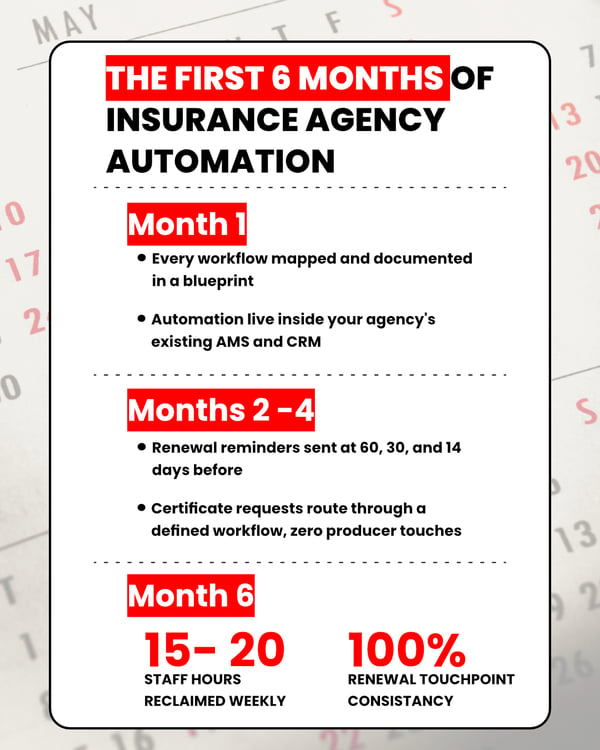
Every Lava engagement starts with a structured build process that maps your existing workflows, identifies the bottleneck costing you the most time, and designs automation around how your agency operates.
Once that mapping is complete, Lava configures your automation inside your existing AMS and CRM, and your team learns which tasks now have a different owner.
Most agencies do not see dramatic results in the first 30 days, and that is by design. A build that goes live too fast without proper mapping breaks under real client volume.
What you should see by day 30 is a documented blueprint of every workflow being automated, a live system running in a controlled way, and a team that understands what changed and why.
What Changes Between Month Two and Month Four
This is where the operational shift becomes visible.
Renewal reminders are typically scheduled at 60, 30, and 14 days before expiration, but that cadence is configured to match how your agency has historically communicated with clients.
Lead follow-up sequences trigger automatically once a new inquiry arrives. Certificate requests route through a defined workflow, with routing logic tailored to your specific carriers and the types of requests you process most often.
Producers notice the interruptions disappearing first. The certificate that used to take twenty minutes now does not reach them at all. What is left on their calendar is mostly client conversations.
Lava's team stays involved through this window with structured performance reviews, refining workflows based on how they actually perform against your real client data.
To see exactly what this build process looks like from kickoff to go-live, read: How Lava Builds and Launches Automation Inside an Insurance Agency.
What Still Requires Human Involvement Six Months In
What automation removes is the work that never required a license. Six months in, several things still require a person.
1. Judgment-dependent situations
Policy recommendations and any exception that falls outside the standard workflow require a licensed producer. A client with an unusual claim history or a renewal conversation that turns into a coverage review requires judgment that automation cannot provide.
2. Agencies with less predictable conditions
The six-month timeline reflects a typical implementation where the agency's workflows were mapped accurately, and the team adopted the new system as designed.
3. Relationship work Lava leaves with your team by design
Some workflows are deliberately not automated, because the relationship itself is the value the client is paying for. Sensitive claims conversations and complex client discussions fall into this category regardless of how automation-ready the rest of your operation becomes.
To understand where that line sits across different parts of an agency, read: Insurance Automation Software vs Human Support: Where Each Has Limits.
The Numbers That Move by Month Six
The qualitative shift shows up in specific numbers by month six.
15 to 20 staff hours reclaimed every week
Those hours come directly out of the administrative fragments that automation now owns.
Renewal touchpoint consistency reaches 100 percent
Agencies that previously had inconsistent renewal outreach typically see every client receiving the full reminder sequence.
Up to 25 percent new business premium growth in year one
Ross Bennett at Heaton and Bennett Insurance doubled new business premium in his first full year working with Lava, growth that came directly from automation freeing up the time his team needed to sell more.
Cross-sell identification that did not exist before.
Agencies frequently discover a meaningful number of single-line clients eligible for cross-sell outreach that had never been previously contacted.
What a Typical Day Looks Like Inside Your Agency at Month Six
You walk into the office on a Tuesday in month six and check your dashboard before your first call.
- Three renewal reminders went out overnight to clients hitting their 60-day mark.
- Two leads that came in over the weekend received an acknowledgment, and a follow-up sequence is running.
- A certificate request that arrived at 6 am is already processed and sent, and you never saw it.
Your first meeting is with a client who responded to a cross-sell outreach they received automatically. Your second call is a renewal conversation with a client who is already engaged because the reminder sequence kept them informed. By lunch, you have had four selling conversations and touched zero pieces of paperwork.
It is a normal Tuesday, six months into working with Lava.
What Six Months With Lava Requires
Six months ago, the questions at the start of this article probably did not have confident answers. Renewals slipped. Producers absorbed work that never required their license. That cost was real but hard to see clearly, because it was distributed across dozens of small interruptions rather than concentrated in one obvious problem.
The Tuesday described above is what happens once the mapping is accurate, the team adopts the new workflows, and the right tasks get automated.
At Lava Automation, we build insurance agency automation systems mapped to your workflows and tested against your data. Our team stays involved through performance reviews and ongoing support, because a build that works on day one and drifts by month three was never actually finished. Over $4 billion in premium already runs on what we have built across more than 300 agencies, all under one SOC 2-certified partnership.
Book a 30-minute demo to see exactly how Lava maps your current workflows and shows you what that Tuesday could look like inside your agency.
Frequently Asked Questions
How long does it take to see results from insurance agency automation with Lava?
Most agencies see the operational shift become visible between month two and month four, with the full impact on staff hours, renewal consistency, and new business growth clearly measurable by month six.
What changes first after implementing insurance agency automation?
Renewal reminders and lead follow-up sequences are typically the first workflows Lava automates, since they follow the most predictable patterns and deliver the fastest visible relief.
What still requires a licensed person after automation is implemented?
Coverage conversations, policy recommendations, and any exception that falls outside a standard workflow still require licensed judgment. Automation flags these situations and routes them to the right person.
