

Are you trying to figure out whether your agency needs automation software, a virtual assistant, or both?
Have you invested in insurance automation software expecting it to reduce your team's workload, only to find that some problems are still falling through the cracks?
Most agency owners reach this question after growth creates more operational work than their team can absorb. The inbox is full, and producers are spending time on tasks that have nothing to do with selling.
What starts as a few delayed follow-ups gradually becomes missed revenue opportunities. Something needs to change, but it is not always clear whether the answer lies in a better system or in more people.
At Lava Automation, we have built insurance automation software and placed trained virtual assistants inside more than 300 agencies. We have seen both approaches work and both approaches fail. The difference is rarely in which one was chosen.
In this article, you will learn what insurance automation software does well, where it breaks down, what virtual assistants handle that software cannot, and how the most operationally sound agencies use both working together.
What Insurance Automation Software Actually Does
Insurance automation software follows rules. It executes the same sequence every time based on conditions you define inside your CRM.
That looks like:
- Renewal reminders trigger automatically based on policy expiration dates
- New leads are routed from intake forms directly into the CRM
- Follow-up sequences launch when a record reaches a specific status
- Certificate requests generate confirmation messages the moment a form is submitted
The value of insurance automation software is consistency. Work moves on schedule regardless of who is in the office or how busy the day is.
For high-volume, clearly defined tasks that repeat on a predictable schedule, automation removes the dependency on human memory and manual follow-through.
Where Insurance Automation Software Reaches Its Limits
Automation executes on the system it is built on. When the underlying conditions are met, it fires. When they are not, it stops.
Consider what happens when a client submits a certificate request with incorrect policy details. The automation creates the task and sends the confirmation, but missing information goes unrecognized. The workflow completes while the actual service request stalls.
Insurance automation software cannot recognize when an exception falls outside its rules, or when a situation requires judgment.
These are the natural limits of any rule-based system. Automation handles volume and not ambiguity.
What Virtual Assistants Do Inside an Insurance Agency
A trained virtual assistant works inside the same systems as your automation.
They monitor task movement, verify information, and handle the situations that fall outside the defined rules.
Here is what that looks like in practice:
- Where automation sends the renewal reminder, a virtual assistant confirms the carrier received it and follows up when they have not
- Where automation routes the certificate request, a virtual assistant reviews the details before the certificate is issued
- Where automation flags an incomplete record, a virtual assistant corrects the data so the next automated step fires correctly
Human support handles what automation cannot, which is everything that requires observation and judgment.
This is why agencies that deploy automation without human oversight run into the same problem. Errors that a trained team member would have caught in seconds run undetected. Exceptions pile up. Client-facing outputs go out incorrectly.
To understand how this combination works inside a growing agency, read: Why Insurance Agencies Use Virtual Assistants with Automation
Where Virtual Assistants Have Their Own Limits
A virtual assistant is not a replacement for insurance automation software either.
A virtual assistant cannot send 500 renewal reminders without fail. They cannot simultaneously monitor every open task across every account in your CRM. They cannot trigger a follow-up sequence when a record changes status without manually checking it.
When virtual assistants are assigned high-volume repetitive tasks that automation could handle, two things happen:
The virtual assistant's time is consumed by tasks that do not require human judgment, and the agency loses the consistency and speed that only automation provides. Both layers underperform when one is carrying work designed for the other.
How Insurance Agencies Use Automation Software and Virtual Assistants Together
The agencies that get the most out of insurance automation software are those that build their workflows around a clear division of responsibilities.
Automation owns the volume. Every task that repeats on a defined schedule, follows a consistent sequence, and does not require a judgment call belongs in the automation layer.
Virtual assistants own the exceptions. Every situation that falls outside the automation rules, involves a client relationship, or depends on carrier communication, belongs with a trained virtual assistant.
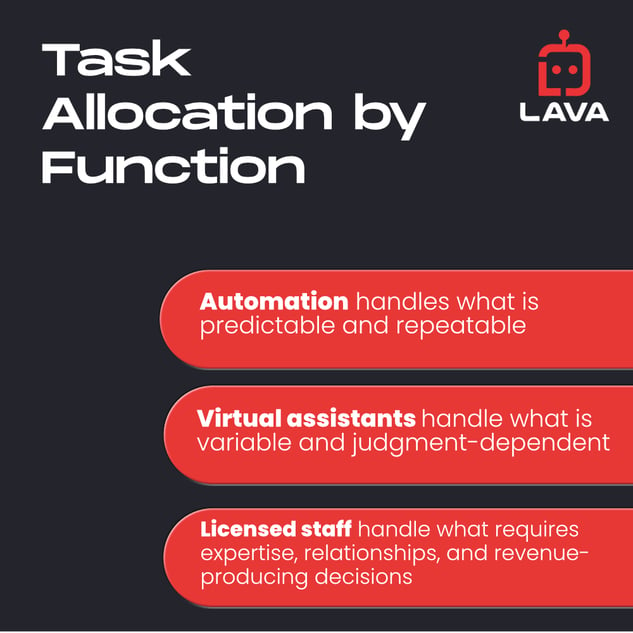
- Automation handles what is predictable and repeatable
- Virtual assistants handle what is variable and judgment-dependent
- Licensed staff handle what requires expertise, relationships, and revenue-producing decisions
When each layer carries the work it was designed for, the operation runs consistently at scale without adding unnecessary overhead.
Is Your Insurance Agency Ready for Automation Software?
You came into this article trying to understand where insurance automation software ends and where human support begins. The answer is not one or the other.
Automation software handles the repeatable, rule-based work that should never require your team's attention. Virtual assistants handle the exception and judgment calls that no software can resolve.
The administrative pressure your agency is feeling right now is a structural problem, and the solution requires both working together.
The question now is whether your current structure gives each layer the work it was built for.
At Lava Automation, we build insurance automation software that integrates with your existing workflows and pairs it with trained virtual assistants to maintain the accuracy and oversight that automation alone cannot provide. Over $4 billion in premium runs on what we have built across more than 300 agencies.
If you want to understand the most common mistakes agencies make when implementing automation before the structure is ready, read: Common Automation Mistakes That Waste Thousands of Dollars
Frequently Asked Questions
What does insurance automation software do for an independent agency?
Insurance automation software handles repeatable, rule-based workflows such as renewal reminders, lead routing, follow-up sequences, and task assignments. It executes the same process consistently without relying on manual follow-through.
Where does insurance automation software fall short?
Automation cannot recognize exceptions, verify incomplete information, or respond to situations that fall outside its defined rules.
Do insurance agencies need both automation software and a virtual assistant?
Most growing agencies benefit from both. Automation handles the volume of repeatable tasks while a trained virtual assistant catches exceptions and handles the judgment-dependent work.
What tasks should be automated versus handled by a virtual assistant in an insurance agency?
Automation works best for high-volume, clearly defined tasks that follow a consistent sequence with no judgment required. Virtual assistants work best for tasks that involve exceptions, verification, carrier communication, or client relationships.
How does Lava combine insurance automation software with virtual assistant support?
Lava builds automation on top of your existing agency workflows and deploys trained virtual assistants within your systems to maintain accuracy and handle exceptions. The two layers work together so your licensed staff can stay focused on clients and revenue.
