

A business owner spent two weeks comparing three managed IT providers. All three had similar pricing and promised comprehensive security. She signed with the one that responded to her emails the quickest.
Four months later, a server went down on a Friday afternoon. The "fast response time" she was promised turned into a 26-hour wait because after-hours support was a separate add-on nobody mentioned during the sales call. The security audit her insurance carrier requested could not be produced because the provider had never actually completed a SOC 2 certification.
This is a pattern we see constantly at Lava Automation. Businesses arrive after a provider's promises failed to hold up during an actual emergency, and it is almost always because the evaluation stopped at price and features.
By the end of this article, you will know the exact questions every managed IT provider should be able to answer before you sign, and the red flags that should end the conversation immediately.
Why Small Businesses Get Managed IT Evaluations Wrong
Most business owners comparing managed IT services providers focus on the monthly rate and the list of included services.
Both matter, but neither tells you what actually happens when your systems go down at 2 am, when an employee clicks a phishing link, or when a carrier or client asks for proof that your data handling meets a defined security standard.
A provider can offer an attractive price and a long feature list while still leaving significant gaps in coverage.
The right evaluation looks past the proposal and asks what actually happens during a crisis.
What to Ask a Managed IT Services for Small Business Provider About Coverage
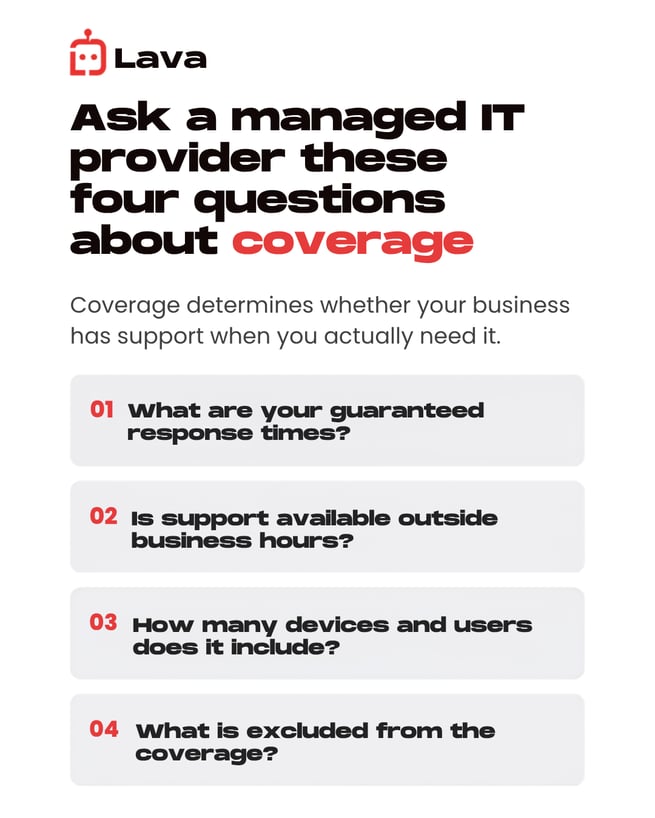
Coverage determines whether your business has support when you actually need it.
- What are your guaranteed response times?
Ask what the response time is for a critical outage versus a minor request, and ask what happens if that commitment is not met.
- Is support available outside business hours?
Systems do not go down on a schedule. If after-hours support is not included in the base price, you need to know that immediately.
- How many devices and users does the coverage include?
Some providers price per device, others per user, and some cap the number of endpoints included before additional fees apply.
- What is excluded from the coverage?
Every proposal has exclusions. Knowing them upfront means you will never be surprised by an invoice for something you assumed was already covered.
What to Ask About Security and Compliance Before Signing
Security and compliance are the areas most small businesses underweight during evaluation, and they are the areas that create the most expensive problems later.
- Is the provider SOC 2 certified?
SOC 2 certification means an independent auditor has verified the provider's security controls against a defined standard. A provider without this certification is operating on self-reported assurances that have never been independently verified.
- What does the endpoint protection actually cover?
You need to know exactly what is monitored on every device, how fast threats are detected, and what happens the moment something suspicious is found.
- How is access managed when an employee leaves?
A delayed offboarding process means a former employee could still have access to your systems long after they are gone.
- Can the provider produce documentation if a client, carrier, or regulator requests proof of your security controls?
Carriers and clients increasingly require proof of security controls before renewing contracts. If your provider cannot produce that documentation, you are stuck scrambling during a compliance review.
To understand what the full financial return on a managed IT investment actually looks like, read: What Is the ROI of Hiring a Managed IT Provider?
What a Strong Managed IT Proposal Actually Looks Like
A strong proposal from a managed IT services provider includes specific, verifiable commitments rather than vague assurances:
- Exact response times in writing, not described as "fast" or "priority"
- The specific SOC 2 certification type, with an offer to share the audit report
- A detailed breakdown of what devices, users, and services are included at the quoted price, and what triggers additional charges
- A clear explanation of the offboarding process for departing employees
- A named point of contact and an escalation path for when something is not resolved
A weak proposal reads well but stays vague on all of these specifics. It uses words like comprehensive and enterprise-grade without defining what those words actually mean in terms of coverage, certification, or accountability.
The strength of a proposal is in how much of it can be verified before you sign.
If a provider hesitates to put any of these specifics in writing, that hesitation is itself the answer.
What Signing With the Right Managed IT Provider Looks Like
You came into this article because you are close to a decision and wanted to make sure you were evaluating the right things before committing.
The businesses that end up frustrated with their managed IT provider almost always evaluated price and features while skipping coverage, security certification, and accountability.
The businesses that end up satisfied asked harder questions upfront and chose the provider who could answer them with specifics rather than reassurance.
At Lava Automation, we operate under a SOC 2 Type 1 certified infrastructure and deploy managed IT services inside growing businesses at $150 per seat per month with 24x5 user support included. Every commitment we make is one we can document and prove.
The next step is a 30-minute demo where we walk through exactly what our coverage includes, show you our security certification, and answer every question on this list directly.
Book a demo to see exactly what we would build for your business.
Frequently Asked Questions
What should I ask a managed IT services for small business provider before signing?
Ask about guaranteed response times, after-hours support availability, SOC 2 certification, endpoint protection details, and the offboarding process for departing employees.
What is the most common mistake small businesses make when choosing a managed IT provider?
Evaluating price and feature lists while skipping questions about coverage, response time guarantees, and security certification. These gaps rarely surface until an incident occurs.
Why does SOC 2 certification matter when choosing managed IT services for a small business?
SOC 2 certification means an independent auditor has verified the provider's security controls. A provider without this certification is operating on self-reported claims that have never been independently confirmed, which becomes a serious liability.
What does a strong managed IT proposal include?
Specific written response time commitments, named security certifications with documentation available, a detailed list of what is and is not included at the quoted price, and a clear escalation process when something goes wrong.
How much do managed IT services for a small business typically cost?
Managed IT services from a provider like Lava run approximately $150 per seat per month with endpoint protection, email security, backup and recovery, and 24x5 user support included.
