

Has your agency grown to the point where the administrative work is consuming the same hours you used to spend closing new business?
Have you noticed your pipeline stalling because you no longer have the time to work them?
Growth is supposed to mean more revenue and more momentum. For most Farmers agents, it also means more service requests and renewal touchpoints that must pass through someone. The activity that built your book starts competing with the activity required to service it.
Across the Farmers agencies we have worked with, the pattern is consistent. The agents who keep growing past this point are those who built a structure that absorbs the operational volume before it reaches their calendar.
At Lava Automation, we support more than 300 growing businesses managing over $4 billion in premium, including Farmers agency owners who have hit this exact ceiling and broken through it.
In this article, you will learn where agency capacity breaks down as the book grows, what tasks should be delegated first, and how leading Farmers agencies reclaim selling time without adding more in-house staff.
Why Farmers Agency Growth Creates a Capacity Problem
The ceiling you are hitting comes down to how many hours in your week are actually available for selling activity.
When your book was smaller, you could carry the administrative load and still have enough time to prospect, follow up, and close.
A Farmers agent managing 300 to 500 clients typically absorbs 20 to 30 renewal touchpoints and 10 to 15 inbound service requests each week, alongside a cross-sell list that grows longer each month. Each task is individually manageable. Collectively, they consume the hours that should be going to prospecting and new business.
Every hour your agency requires you to spend on work that does not require your license is an hour your pipeline misses out on.
The agents who scale past this ceiling have a structure that absorbs the volume, so their selling time stays protected as the book grows.
What an Insurance Virtual Assistant Handles Inside a Farmers Agency
An insurance virtual assistant is built around the specific operational demands of a production-driven agency like yours.
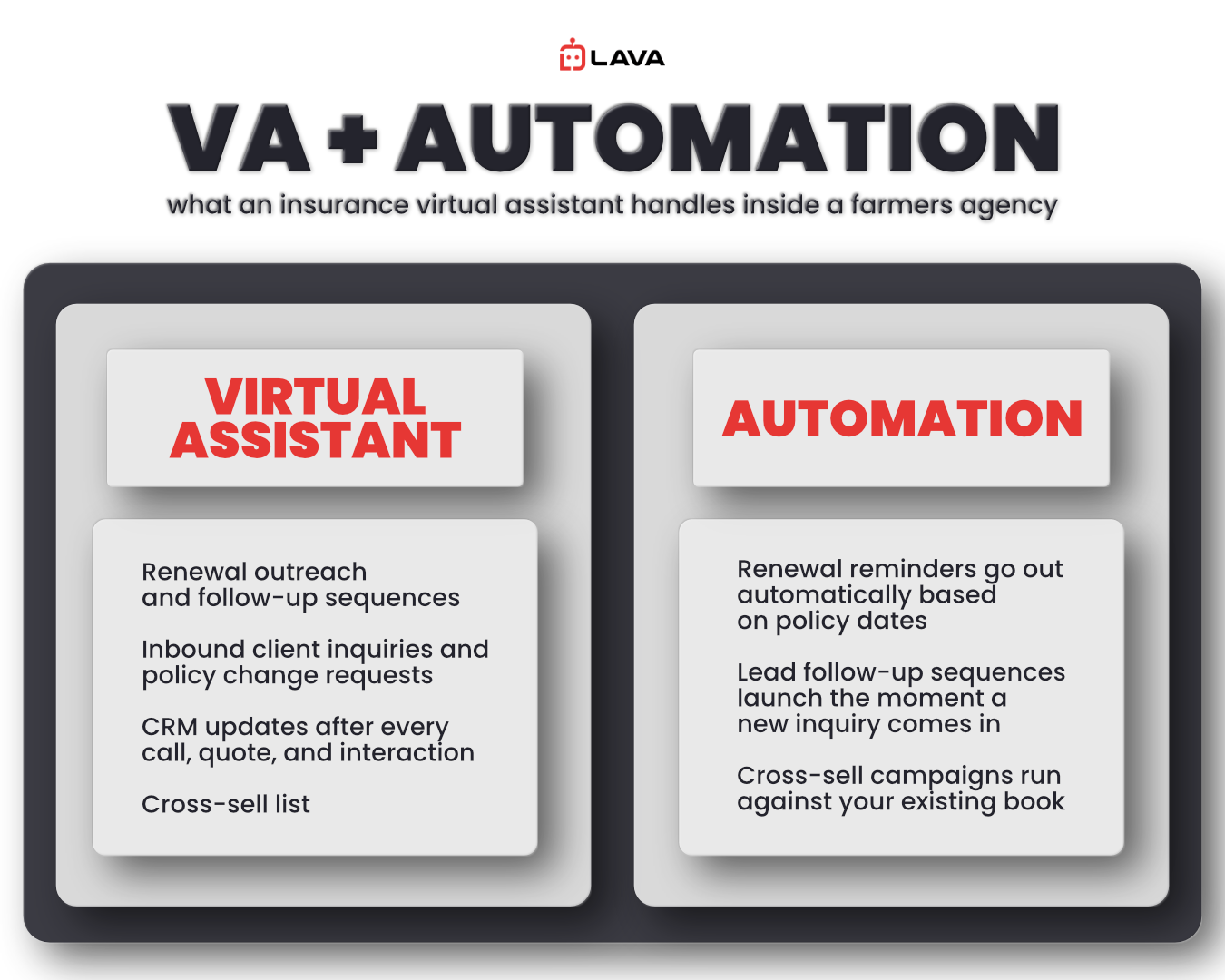
Inside your Farmers agency, your insurance virtual assistant handles:
- Renewal outreach and follow-up sequences
- Inbound client inquiries and policy change requests
- CRM updates after every call, quote, and interaction
- Cross-sell list
When your insurance virtual assistant owns these tasks, your calendar stops filling up with work that does not close policies.
Licensed conversations, coverage explanations, and any interaction that requires your judgment or your E&O coverage stay with you. Those are the tasks that protect your relationships and drive your revenue. That is where your hours belong.
How Automation Keeps Your Pipeline Moving Without You
Your insurance virtual assistant handles the judgment-dependent work. Automation handles the volume that runs on a schedule.
Here is what that looks like inside your Farmers agency:
- Renewal reminders go out automatically based on policy dates
- Lead follow-up sequences launch the moment a new inquiry comes in
- Cross-sell campaigns run against your existing book
Every workflow that repeats and requires no judgment call belongs in your automation layer.
Your insurance virtual assistant and automation together mean your agency operates as if it has more capacity than it actually does.
How an Insurance Virtual Assistant and Automation Work Together
The reason most Farmers agents hit the capacity ceiling is that they use one without the other, and each layer has its own limit.
Automation is precise and reliable up to the edge of its rules. Beyond that edge, it has nothing left to offer. When a renewal reminder goes unanswered, the automation completes its job. What happens next requires a person.
Your insurance virtual assistant is that person. When the automation flags an exception, your virtual assistant resolves it. When a cross-sell list needs a personal outreach rather than a templated email, your virtual assistant makes the call.
Together, your insurance virtual assistant and automation create a pipeline that moves consistently at scale without requiring your involvement in the execution.
The agents using both layers reclaim 15 to 20 staff hours each week because the right work always reaches the right person.
To understand why combining both consistently outperforms using either one alone, read: Why Insurance Agencies Use Virtual Assistants with Automation
What Your Farmers Agency Looks Like When Both Layers Are in Place
Your renewal list is being worked on without you tracking it. Your cross-sell outreach is going out consistently. Your inbound service requests are handled without pulling you off a prospecting call. Your CRM is up to date without manual entry.
What is left on your plate is the work that only you can do. The conversations that require your voice. The relationships that require your judgment. The closing activity requires your license.
Agencies using this structure with Lava see up to 25% new business premium growth in the first year. That growth comes from making sure your hours go to the activity that actually builds your book.
How Farmers Agents Scale Their Book Without Adding More Hours
As your Farmers agency grows, the challenge becomes protecting the time needed to sell it.
You came to this article because your agency was growing, but your sales time wasn't keeping up. Now you understand where capacity breaks down, which tasks should leave your plate first, and what the structure looks like when both layers are running together.
The capacity ceiling you are hitting is a time issue, and it is solvable. An insurance virtual assistant takes the non-selling work off your plate. Automation keeps your pipeline moving on schedule. Together, they protect your selling time as your book grows.
The agents who scale Farmers agencies past the capacity ceiling have a structure that works for them.
At Lava Automation, we build that structure inside Farmers' agency operations. Your insurance virtual assistant is trained on your workflows and your CRM from day one. Your automation runs your renewal reminders, cross-sell sequences, and follow-up workflows without manual oversight. All under one partnership.
If you want to understand what this investment costs before you commit, read: What Does a Lava Automation Virtual Assistant Cost Per Month?
Frequently Asked Questions
How does an insurance virtual assistant help a Farmers agent handle growth without working more hours?
Your insurance virtual assistant takes ownership of renewal outreach, service requests, CRM updates, and cross-sell follow-up.
What is the difference between an insurance virtual assistant and automation for a Farmers agency?
Your insurance virtual assistant handles judgment-dependent tasks that require observation and follow-through. Automation handles high-volume, repeatable workflows that run on a schedule.
Can an insurance virtual assistant work inside the systems my Farmers agency already uses?
Yes. Your Lava virtual assistant is trained to work inside your CRM and agency management systems from day one without disrupting how you currently operate.
