

A producer handed her new virtual assistant a task on a Monday morning. "Follow up with the renewal list." By Thursday, three renewals had already lapsed. The virtual assistant had been working the whole time, contacting clients in the wrong order and flagging exceptions to no one in particular because no one was told to check.
Agency owners assume that hiring an insurance virtual assistant is the hard part. The harder part is actually setting them up to succeed once they start. A vague instruction or an unclear feedback loop produces the same disappointing result regardless of the person's capability.
At Lava Automation, every insurance virtual assistant we place is drawn from the top 1% of applicants and trained on your specific systems. Agencies working with us reclaim 15-20 staff hours each week once the full setup is in place. Even so, that setup requires properly structuring the surrounding work.
In this article, you will learn why capable virtual assistants still fall short without the right setup, the five elements every task needs, how to break your workflows into ownable pieces, and the other factors that determine whether your virtual assistant succeeds from day one.
Why a Capable Insurance Virtual Assistant Still Falls Short Without the Right Setup
The instinct when delegating is to describe the outcome. "Handle renewals." "Follow up with leads." "Keep the CRM updated." These instructions sound clear to the person giving them because the full context lives in their head. Yet it is not clear to the person receiving them.
Most missed tasks come down to one thing. Something was assumed instead of stated.
A capable person given an unclear task and no feedback will produce inconsistent results every time.
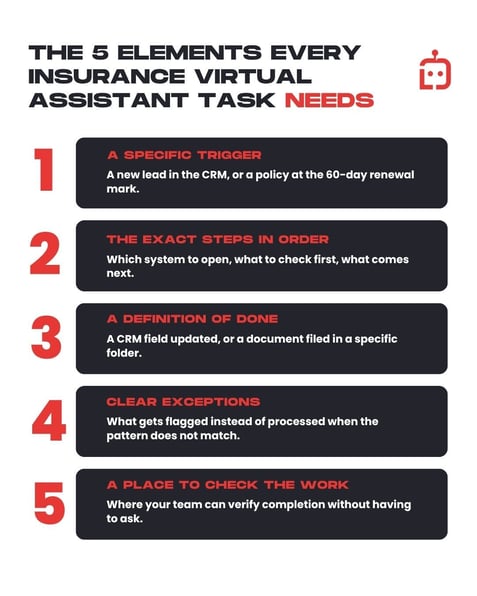
The 5 Elements Every Insurance Virtual Assistant Task Needs
A task is ready to hand off to your insurance virtual assistant when it includes all five of these elements.
A specific trigger
What causes this task to start. A new lead entering the CRM, or a policy hitting the 60-day renewal mark.
The exact steps in order
Which system to open, what to check first, what comes next.
A definition of done
What the finished task actually looks like. This could be a CRM field updated or a document filed in a specific folder.
Clear exceptions
What happens when the situation does not match the standard pattern, and what gets flagged instead of processed.
A place to check the work
Where you or someone on your team can verify the task was completed correctly without having to ask.
To understand what other questions matter before you bring on virtual assistant support, read: What Questions Should I Ask Before Hiring a Virtual Assistant Company?
How to Break Down Insurance Workflows Into Tasks Your Virtual Assistant Can Own
"Manage renewals" is not a task. It is an entire area of the business made up of dozens of smaller, repeatable actions.
Start by writing out every step in your workflow, in the order they occur. For renewal outreach, that looks like:
- Identify accounts hitting the 60-day mark
- Pull the client's current policy details
- Send the first reminder
- Log the contact in the CRM
- Wait for a response
- Send a second reminder at 30 days if no response
- Flag the account for producer outreach at 14 days if still no response
Each one of those steps is a task your insurance virtual assistant can own completely once it has a trigger, a process, a definition of done, exceptions, and a way to check it.
Break the workflow down until every remaining piece has a single clear trigger and a single clear outcome. If a task still contains a decision that requires your judgment, it is not ready to fully hand off yet.
The Other 3 Factors That Determine Whether Your Virtual Assistant Succeeds
Three additional factors decide whether that structure actually holds once your virtual assistant starts working.
Access to the right systems from day one
A virtual assistant cannot execute a well-structured task if they are locked out of the CRM or the specific folder where documents live. Confirm every login and permission is in place before their first task.
Clear communication channels and response expectations
Your virtual assistant needs to know exactly where to ask a question and what to do if nobody answers in time. Without this, small uncertainties can stall work.
A fast feedback loop in the first few weeks
A virtual assistant who goes two weeks without hearing anything will keep repeating the same small errors because nobody told them otherwise.
What a Well-Set-Up Insurance Virtual Assistant Actually Delivers
What if the hire was the wrong call? What if this becomes another thing that didn't work out, another few months spent training someone who never quite got there, another reason to go back to doing it all yourself?
The hire was capable, and the instructions felt clear enough in your own head. And somehow the results kept missing anyway.
The gap lies in the setup around them. A clearly structured task paired with the right access, communication, and feedback removes the guesswork that was causing the breakdown.
When the full setup is in place, tasks are completed on the first try and questions are resolved within hours, rather than sitting unanswered for days. Your virtual assistant becomes someone you can hand a workflow to and trust it will run the same way every time.
At Lava Automation, we start by mapping your workflows and systems before we ever select a candidate, so the virtual assistant matched to your agency is built for how you operate. Every insurance virtual assistant who reaches you is already in the top 1% of applicants, trained on your specific systems, and supported by our team to make sure the full setup holds.
To understand exactly what onboarding a virtual assistant looks like from the first day forward, read: What to Expect When Onboarding a Virtual Assistant for a Small Business
Frequently Asked Questions
Why does my insurance virtual assistant keep missing tasks?
Most missed tasks trace back to the setup. A task described only by its outcome, lacking system access, or lacking a feedback loop will produce inconsistent results regardless of how capable the person is.
What makes a task ready to hand off to an insurance virtual assistant?
A ready task includes a specific trigger, the exact steps in order, a clear definition of done, documented exceptions, and a way to check the completed work.
What else does a virtual assistant need besides a clear task?
Full access to the systems required to complete the work, a clear communication channel, and a fast feedback loop during the first few weeks to correct early mistakes quickly.
What does Lava do to make sure a virtual assistant setup succeeds?
Every Lava virtual assistant is trained on your specific systems and workflows. Our team stays involved to help structure the full setup, including access, communication, and feedback.
