

Are you considering hiring a virtual assistant for your insurance agency but hesitating because you are not sure the investment will actually improve your business?
Are you worried about increasing overhead, uncertain about the ROI, or concerned about getting the tax treatment wrong?
That hesitation is common among agency owners. You want to know the true cost of the hire before they commit, and whether the IRS will recognize it as a legitimate business expense.
At Lava Automation, we support more than 300 growing businesses with trained virtual assistants placed inside their workflows. Through those engagements, tax deductibility is one of the most common questions business owners ask before committing to the investment.
In this article, you will learn whether hiring a virtual assistant for insurance agents qualifies as a tax-deductible business expense, what documentation supports that deduction, and how to approach the cost as part of your agency's overall financial strategy.
Is a Virtual Assistant for Insurance Agents a Tax-Deductible Business Expense?
In most cases, yes. The IRS allows businesses to deduct ordinary and necessary business expenses, meaning costs that are common in your industry and appropriate for your operations.
A virtual assistant handling certificate processing, renewal preparation, CRM updates, and client follow-ups for an insurance agency meets both criteria.
This applies whether you hire through a staffing agency like Lava or engage a virtual assistant directly, though the worker's classification and how you pay them affect how the deduction is reported.
What Virtual Assistant Costs Are Typically Deductible for Insurance Agents?
The deductible costs associated with a virtual assistant for insurance agents generally fall into a few categories.
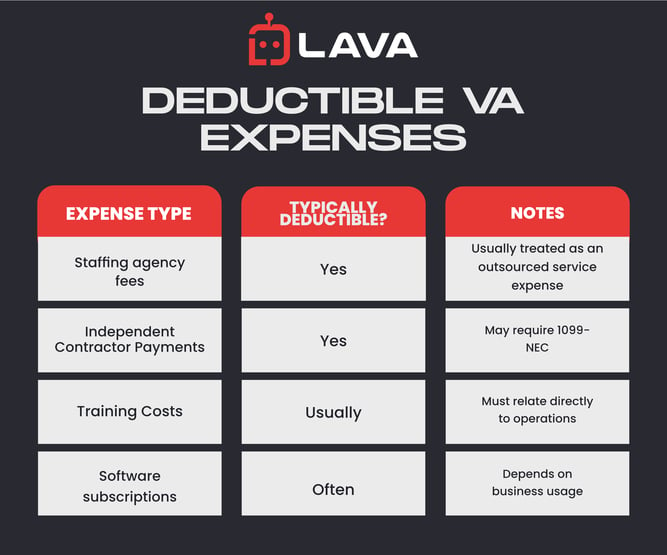
- Service fees paid to a virtual assistant staffing company such as Lava Automation are typically deductible as a business expense. Because you are paying a company for a service, the arrangement is treated similarly to any other outsourced business service.
- Direct payments to an independent contractor virtual assistant are also generally deductible, provided the worker qualifies as an independent contractor rather than an employee under IRS guidelines.
- Training and onboarding costs directly related to preparing a virtual assistant to support your agency operations may also qualify as deductible business expenses.
The key principle is that the expense must be directly connected to operating your insurance agency.
Equipment, software subscriptions, and access costs associated with your virtual assistant's work inside your systems may also qualify, depending on how they are structured. A tax professional can help you identify the full scope of deductible costs.
How Should Insurance Agents Document Virtual Assistant Expenses for Tax Purposes?
Documentation is what converts a legitimate deduction into a defensible one. Insurance agents who hire a virtual assistant should maintain clear records from the start of the engagement.
To see how agencies structure virtual assistant responsibilities and systems access from day one, read: What Can a Virtual Assistant from Lava Automation Do?
Useful documentation includes:
- Invoices or payment records from your virtual assistant or staffing provider
- A written description of the tasks performed and how those tasks support your operations
- Contracts or service agreements that define the scope of work
- Records of any software access or tools provided
Clean documentation protects the deduction and makes tax preparation significantly easier at year's end.
Most agencies working with Lava receive structured invoicing and service agreements as part of the engagement, which simplifies this process considerably.
How Does Hiring a Virtual Assistant for Insurance Agents Affect Overall Agency Finances?
The tax deduction is one part of the financial picture. The more significant impact is operational.
Lava clients typically reclaim 15 to 20 staff hours each week within the first 30 days of placing a virtual assistant. Those hours return to licensed staff who can direct them toward quoting, advising clients, and closing new business.
If a producer generates roughly $250 per hour in revenue-producing activity, reclaiming 15 hours per week creates meaningful selling capacity over the course of a year.
When you factor in the deductible cost of the virtual assistant, the net financial impact is significantly stronger than the gross cost suggests.
The deductible expense reduces your taxable income while the recovered hours increase your revenue-generating capacity.
The combination of a deductible operational expense and measurable revenue impact is what makes the virtual assistant investment one of the most financially straightforward decisions an agency can make.
What to Do Before You Hire a Virtual Assistant for Your Insurance Agency
You came into this article with a financial question, and now the answer is clearer.
In most cases, a virtual assistant supporting an insurance agency qualifies as a deductible business expense. That deduction helps reduce the true cost of the hire, while the operational return often extends far beyond the tax benefit itself.
The administrative pressure that led you to explore virtual assistant support likely still exists. Renewals continue stacking up. Certificates wait in queues. Licensed producers spend valuable hours on tasks that do not generate revenue.
Now you understand that solving those operational bottlenecks actually becomes a measurable investment in efficiency, selling capacity, and long-term growth.
The next step is determining what kind of support structure fits your agency best, how responsibilities should be delegated, and what level of operational impact you should realistically expect.
At Lava Automation, we place top 1% virtual assistants inside insurance agency workflows with structured service agreements and ongoing performance oversight so your operations and your financial planning are both supported from day one.
If the next question on your mind is what this actually costs, we answer it directly here: What Does a Lava Automation Virtual Assistant Cost Per Month?
Frequently Asked Questions
Is hiring a virtual assistant for insurance agents tax-deductible?
In most cases, yes. The IRS recognizes a virtual assistant supporting insurance agency operations as an ordinary and necessary business expense.
What virtual assistant costs can insurance agents deduct?
Staffing agency fees, independent contractor payments, onboarding costs, and software or tools used exclusively for agency work are all potentially deductible.
Does it matter whether the virtual assistant is hired through a staffing company or directly?
Both arrangements are generally deductible, but the reporting differs. Staffing company fees are treated as outsourced service expenses. Direct payments to an independent contractor above $600 in a calendar year typically require a Form 1099-NEC.
How does a virtual assistant affect an insurance agency's bottom line beyond the tax deduction?
Lava clients typically reclaim 15 to 20 staff hours per week, returning that time to licensed staff for revenue-producing work. The deductible cost, combined with increased selling capacity, makes the investment financially strong on both sides.
