

The demo looked impressive, and the proposal covered everything. Six months later, the workflows are running inconsistently, and the agency is paying for a system that requires more oversight than the manual processes it replaced.
The questions that prevent that outcome are not about features, pricing, or platform compatibility. They are about how the provider builds, what they build around, and what happens after the automation goes live.
At Lava Automation, we have built insurance workflow automation systems inside more than 300 agencies managing over $4 billion in premium. The agencies that get the most from their automation evaluated their provider before committing.
In this article, you will find the specific questions worth asking every insurance workflow automation provider before you sign, so you can make a decision you will not have to undo six months from now.
Why Agencies Ask the Wrong Questions Before Choosing an Insurance Workflow Automation Provider
The most common mistake agencies make is evaluating the platform instead of the process.
They ask which CRM integrations are supported, what pricing tiers are available, and how many workflows are included. These are reasonable questions, but they are the wrong starting point.
We see agencies arrive after a failed implementation with the same story. The provider had strong platform demos. The proposal looked thorough. But nobody mapped the existing workflows before the build started, and the CRM data structure was never reviewed. The automation ran in theory and failed in practice.
The questions that matter most should reveal how the provider approaches the build and what accountability looks like after the automation is live.
What to Ask About How the Insurance Workflow Automation Gets Built
The build process is where most automation implementations succeed or fail.
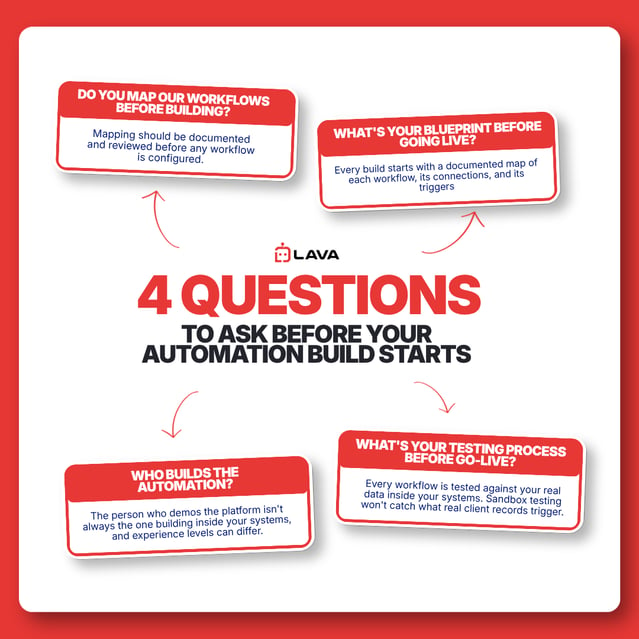
- Do you map our existing workflows before building anything?
The mapping process should be documented and reviewed before a single workflow is configured. - What does your blueprint look like before a single workflow goes live?
Every build should start with a documented map of every workflow, how they connect, and what triggers each one. No blueprint means isolated workflows that will require constant manual fixes. - Who on your team actually builds the automation?
The person who demos the platform and the person who builds inside your systems are often different people at different experience levels. - What does the testing process look like before we go live?
Every workflow should be tested against your actual data inside your systems. Sandbox testing will not catch the failures that surface when real client records trigger the workflows.
What to Ask About Integration With Your Existing Systems
Insurance workflow automation that requires your agency to change its existing systems is just a platform migration in disguise.
- Do you build on our existing AMS and CRM, or should we switch?
If the provider requires a platform change, that requirement must be clearly stated in the proposal, with the full migration cost included. - How do you handle carrier integrations?
Ask specifically which carriers the provider has built around before. A provider who has never built around your carrier combination is learning from your engagement. - What happens when our systems update or change?
Ask whether post-launch system changes require a new engagement or are covered under the ongoing relationship.
Knowing which questions to ask about integration is only half the picture. The other half is understanding which workflows deliver the fastest return once the build is live.
To understand where insurance workflow automation delivers the fastest return inside a growing agency, read: Where Insurance Process Automation Makes the Biggest Impact.
What to Ask About Results From Insurance Workflow Automation
A provider who cannot point to specific, measurable results from their builds is not a provider who has built enough of them to know what works.
- Can you show me results from agencies similar to mine?
These refer to specific outcomes from agencies with a similar premium volume and team size. The answer should include numbers: hours reclaimed, renewal touchpoint consistency, and premium growth. - What does a successful build look like at 30, 60, and 90 days?
The answer should include specific milestones for workflow completion, go-live, and post-launch performance. - What is your average client retention rate?
A provider with strong client retention delivers results worth paying for every time.
What to Ask About Support After Insurance Workflow Automation Goes Live
The build is just the beginning of the relationship that determines whether the automation delivers long-term value.
- What does ongoing support look like after go-live?
Look for structured check-ins on a defined schedule, a named point of contact, and a clear process for requesting adjustments. - Who do we contact when something breaks?
A support ticket with a 48-hour response window is especially important during peak renewal season. Know exactly who you are calling before you sign. - Are post-launch adjustments included or billed separately?
Workflows need refinement after launch. Know upfront whether that refinement is included or costs extra.
How to Choose the Right Insurance Workflow Automation Provider
You came into this article because you were close to a decision and wanted to make sure you were asking the right questions before committing. Now you have them.
In the past, most agencies evaluated automation providers the same way they evaluated any software purchase. They trusted the demo and the proposal. Six months later, they were troubleshooting workflows that never ran as intended.
Now you know to ask how the build gets mapped before anything is configured, which carriers the provider has built around, and what post-launch support looks like before you are in the middle of a renewal season with a misfiring sequence.
The next step is putting those questions to a provider directly and evaluating the answers with the confidence that you know what good looks like.
At Lava Automation, we build insurance workflow automation systems inside your existing AMS, CRM, and carrier workflows, starting with a documented blueprint and including structured performance reviews through week ten. Over $4 billion in premium runs on what we have built across more than 300 agencies, all under one SOC 2 certified partnership.
You now have the questions. The demo is where you get the answers. Book a demo and leave with everything you need to make a confident decision.
Frequently Asked Questions
What should I ask an insurance workflow automation provider before signing?
Ask about their build process, whether they map your existing workflows before configuring anything, how they handle integration with your AMS and CRM, what results they can show from comparable agencies, and what support looks like after go-live.
What is the most common mistake agencies make when choosing an insurance workflow automation provider?
Evaluating the platform instead of the build process. A compelling demo and a competitive price point do not guarantee that the automation will run consistently within your specific systems.
What should be included in an insurance workflow automation build?
A documented blueprint, CRM and AMS integration mapping, escalation logic, testing against real data before go-live, and structured post-launch refinement. Any build that skips the mapping and testing phases will require ongoing manual intervention to keep running correctly.
