

Most conversations about AI in insurance get framed as a replacement question. Will AI take over quoting? Will it replace producers? Will agencies still need people at all in five years? That framing misses what is actually happening inside agencies already using AI tools.
AI is not competing with your producers, but rather the parts of their day that never required them in the first place.
At Lava Automation, we have built automation and AI-supported workflows across more than 300 agencies. The pattern is consistent every time. The agencies winning with AI are the ones who know precisely where to stop.
In this article, you will learn where AI genuinely outperforms human judgment, where human expertise still wins, what happens when agencies get that balance wrong, and how to draw that line inside your own agency.
Is AI Going to Replace Insurance Agents?
The honest answer is no, not in the way most people fear when they ask the question.
AI for insurance agents is genuinely good at pattern recognition, data processing, and repetitive tasks performed at volume.
It is not good at reading a client's hesitation, weighing a nuanced coverage decision against a specific risk tolerance, or building the kind of trust that keeps a client renewing for fifteen years.
The better question is which parts of a producer's day were never actually using their expertise in the first place, and whether AI can take those parts over.
Where AI Outperforms Human Judgment in Insurance
There are specific categories of work where AI consistently outperforms a human, because the work itself rewards speed, consistency, and pattern matching.
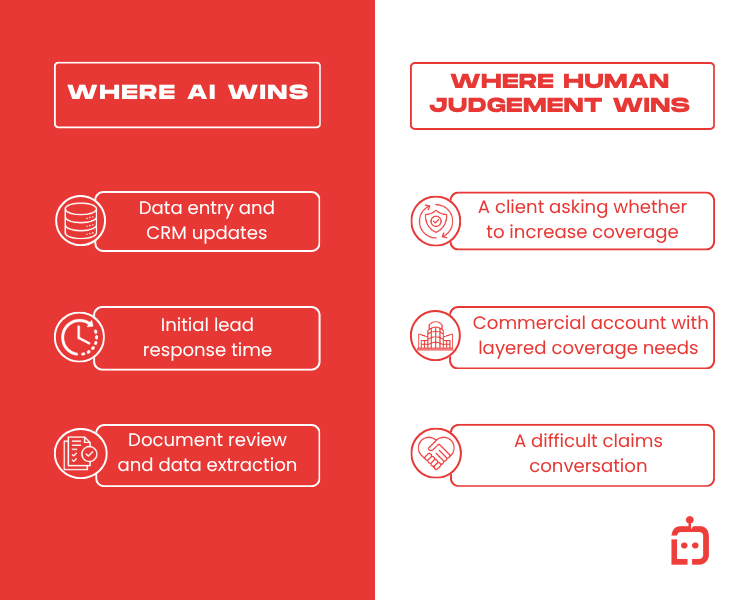
- Data entry and CRM updates are faster and more accurate when handled by AI-supported automation than when a producer manually types the same information after every call.
- Initial lead response time improves dramatically when AI-driven acknowledgment triggers within minutes of a lead entering the pipeline, something no human can match consistently across every single lead.
- Document review and data extraction, pulling policy details, matching information across systems, and flagging inconsistencies happen faster and with fewer errors.
These are volume tasks where consistency matters more than nuance, and AI wins on both counts.
Where Human Judgment Still Beats AI in Insurance
The categories where human judgment still wins share a common thread: they all require context that AI cannot access no matter how sophisticated the model becomes.
- A client asking whether to increase coverage after a life change requires understanding their risk tolerance and financial picture.
- A complex commercial account with layered coverage needs requires a producer who understands the client's business well enough to identify a gap the client did not even know to ask about.
- A difficult claims conversation requires empathy, patience, and the ability to read what a client actually needs in that moment, whether information or reassurance.
These are tasks that require a kind of contextual judgment that is fundamentally different from pattern recognition, and that difference is not going away.
To understand exactly where the line sits across different parts of an agency, read: Insurance Automation Software vs Human Support: Where Each Has Limits
The Risks of Over-Relying on AI in Insurance Agencies
Let’s picture a scenario.
A mid-sized agency implemented an AI tool to handle initial client intake and coverage recommendations for new business quotes. The tool worked well for straightforward, single-line policies. Yet it struggled the moment a prospect had a slightly unusual situation, a home-based business, a recent claims history, or multiple properties with different risk profiles.
Rather than flagging these cases for a producer, the AI tool generated generic recommendations anyway, because it had been configured to always produce an output rather than to recognize when it had reached the edge of what it could reliably handle.
The tool was doing exactly what it was built to do. The agency had simply never defined where the AI's authority should end, and a producer's review should begin.
The risk with AI in insurance is deploying AI without a clearly defined boundary for when a human needs to step in.
How to Balance AI and Human Judgment in Your Insurance Agency
Getting this balance right starts with mapping your actual workflows and identifying which parts are volume-driven and pattern-based versus which parts require contextual judgment.
Renewal reminders, initial lead acknowledgment, and CRM data entry are strong candidates for full AI ownership, since they are repetitive and do not require nuance.
Coverage recommendations for anything beyond a straightforward, single-line policy should always route to a producer for review, even if AI generates an initial draft. Claims conversations and any client interaction involving an unusual or emotionally significant situation should stay entirely with your licensed staff.
What Actually Determines Whether AI Helps or Hurts Your Agency
You came into this article wondering whether AI is something to embrace or something to be cautious about in your agency. The honest answer is both, depending entirely on where you draw the line.
AI for insurance agents genuinely outperforms human judgment on volume, speed, and consistency for repetitive, pattern-based work.
Human judgment remains irreplaceable for anything requiring context, empathy, or nuanced decision-making.
The agencies that get the most value from AI are those who mapped their workflows carefully enough to know exactly where AI's authority should end.
At Lava Automation, every automation and AI-supported workflow we build starts with mapping your agency's specific processes, so the line between AI and human judgment is drawn deliberately. Over $4 billion in premium runs on what we have built across more than 300 agencies.
Getting that balance right is not something most agencies figure out by trial and error. To understand why building it correctly the first time matters more than doing it quickly, read: Why Expert-Built Automation Outperforms DIY for Insurance Agencies
Frequently Asked Questions
Is AI going to replace insurance agents?
No. AI for insurance agents handles repetitive, pattern-based work well, but it cannot replicate the contextual judgment, empathy, and nuanced decision-making that complex coverage conversations and claims require.
Where does AI perform best in an insurance agency?
AI performs best on volume-driven, repetitive tasks like CRM data entry, initial lead acknowledgment, document review, and data extraction, where speed and consistency matter most.
Where does human judgment still matter most in insurance?
Complex coverage recommendations, commercial accounts with layered needs, and claims conversations that require empathy and context all still require human judgment.
How do I know where to draw the line between AI and human judgment in my agency?
Map your workflows and separate volume-driven, repetitive tasks from anything requiring context or nuance. Repetitive tasks are strong candidates for AI ownership. Anything involving judgment should route to a producer for review.
