

Do your clients ever ask how you protect their information? If they do not ask, does that mean they do not care?
Most clients will not investigate your security practices until they have a specific reason to, such as a data breach, a compromised email account, a fraudulent payment request, or a moment when their personal information feels exposed. But the moment that reason appears, your response and the systems behind it affect whether that client stays.
At Lava Automation, we have built managed IT services specifically for insurance agencies, working inside the day-to-day reality of handling sensitive client data.
That experience has shown us something most agency owners do not expect: clients notice far more about an agency's security posture than owners assume, and the moments where that noticing turns into a lost relationship are almost always preventable.
In this article, you will learn what clients notice about your agency's IT security, what happens to trust after a security incident, and what to look for when evaluating whether your current setup is protecting you the way you think it is.
Do Your Clients Care About Your Agency's IT Security?
The honest answer is that most clients do not think about your IT security until they have a specific reason to.
That reason usually arrives in one of two ways. Either something goes wrong, and they find out the hard way, or they ask a direct question during onboarding or a renewal, and your answer either reassures them or does not.
Silence from a client just means the question has not come up yet.
Clients handling sensitive information, business owners, healthcare providers, and financial professionals are more likely to ask directly. A general consumer client might never ask at all, right up until a data breach makes the local news and they wonder whether their information was part of it.
What Clients Look For Before Trusting an Agency With Their Data
When clients think about security, a few specific signals shape their confidence.
- Whether the agency communicates through secure channels or sends sensitive documents over unencrypted email
- Whether a client portal or client-facing system feels current or outdated
- How the agency responds when asked a direct question about how their data is protected
None of these signals require an in-depth understanding of encryption standards or certification frameworks. They only require a client to notice whether the agency seems to have its operational house in order, and IT security is one of the clearest signals of that.
What Happens to Client Trust After a Security Incident
A 15-person independent agency experienced a phishing attack that compromised one employee's email account. The attacker used that access to send fraudulent payment redirection requests to several clients who were in the middle of a claims process.
They spent weeks in damage control mode, calling clients one by one, hiring outside counsel, and trying to reconstruct how much had been compromised.
The financial loss was significant, but the more lasting damage was reputational.
Word spread quickly among a small, tightly connected client base. Several long-standing clients moved their policies to competing agencies because the one thing an insurance agency is supposed to protect, trust, was the thing they failed to protect first.
Trust that took a decade to build eroded in a matter of weeks, and eighteen months later, the agency still has not fully recovered the book of business it lost.
To understand exactly what happens operationally and financially after a breach like this one, read: What Happens to a Small Business After a Data Breach.
Is Your Agency's IT Environment as Secure as You Think?
You have 15 employees. Client files move between a handful of shared drives that different people access from different devices. Two employees who left the agency still have credentials because nobody built an offboarding checklist for IT access.
Your email security has not been reviewed since the platform was set up three years ago. You have never asked your current IT provider whether they hold a SOC 2 certification, and you assume the antivirus software is sufficient protection because nothing has gone wrong yet.
Nothing going wrong yet is not the same as nothing being wrong.
Is your agency’s IT environment as secure as you think?
What to Look for When Evaluating Your Agency's IT Security
The gaps described above are common, and there is no single fix that closes all of them. Different agencies address them in different ways, whether that means hiring internal staff or working with a managed provider.
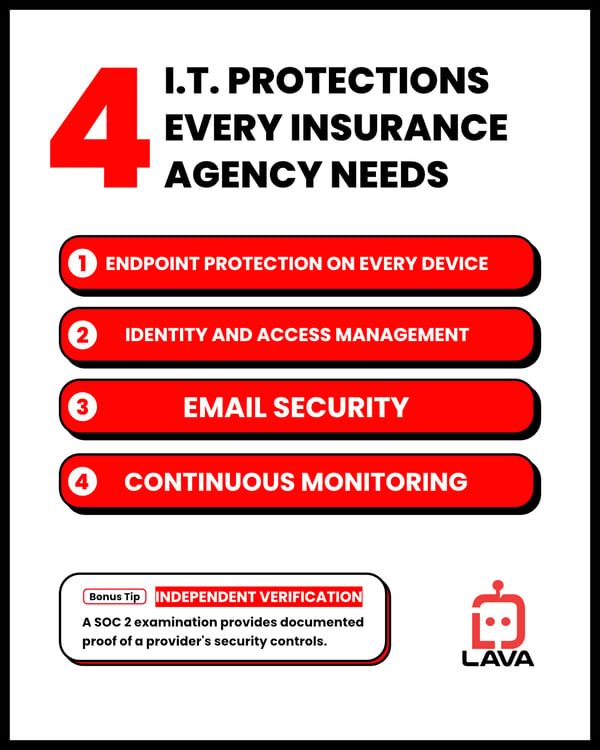
Whatever approach an agency takes, a few categories of protection consistently matter most:
- Endpoint protection, which monitors devices connected to the network for suspicious activity
- Identity and access management, which controls how quickly access is granted and revoked per employee
- Email security, which is designed to reduce the number of phishing attempts that reach an inbox
- Ongoing monitoring, which is meant to catch unusual activity closer to when it happens
Independent verification matters here too. A SOC 2 Type 1 examination provides documented proof of a provider's security controls, which can matter if a client or regulator ever asks for it.
What It Actually Takes to Earn Your Clients' Trust
You came into this article assuming your clients evaluate your agency on price, coverage, and service. They do, but that evaluation happens alongside a quieter one they rarely voice directly: whether your agency can actually be trusted with their information.
Most agencies discover the answer to that question only after something has already gone wrong, when a client asks a pointed question they cannot answer confidently, or when a breach forces the issue into the open. By then, the cost is no longer hypothetical.
At Lava Automation, we built our managed IT services for insurance agencies around a SOC 2 Type 1 certified infrastructure, so your agency never has to answer a security question with anything less than a specific, documented response.
The agencies that wait until something breaks always pay more than the ones that acted first. Understand exactly what that return looks like before you become the example. Read: What Is the ROI of Hiring a Managed IT Provider?
Frequently Asked Questions
What do clients notice about an agency's IT security?
Clients notice whether communication happens through secure channels, whether client-facing systems feel current, and how confidently an agency answers direct questions about data protection.
What happens to client trust after a data breach at an insurance agency?
Trust erodes quickly, often faster than it was built. Clients frequently leave because they no longer feel confident their information is protected.
What do managed IT services for insurance agencies actually cover?
Endpoint protection, identity and access management, email security, and continuous monitoring, typically backed by SOC 2 certification that provides documented, independently verified proof of these protections.
How can an agency know if their current IT security is sufficient?
If your agency has never confirmed your IT provider holds SOC 2 certification, cannot document an offboarding process for departing employees, and has not reviewed email security in years, those are strong signs of unaddressed risk regardless of how quiet things have been.
