

Every hour a licensed producer spends on paperwork is an hour they are not selling. That math sounds obvious once stated out loud, and yet most growing insurance agencies still run their day-to-day as if administrative work and selling work belong to the same person by default.
They do not have to. Insurance process automation exists specifically to separate the two, and the agencies that make that separation early see the difference in their numbers within months.
At Lava Automation, we have built insurance process automation systems inside more than 300 agencies managing over $4 billion in premium. The pattern is consistent across nearly every one of them.
The producers spending the most time on manual administrative work are almost always the same producers whose selling numbers have plateaued, because their calendar has no room left for the activity that actually generates revenue.
In this article, you will learn why manual administrative work quietly drains producer productivity, what insurance process automation actually removes from a producer's day, and what to look for when evaluating a solution for your agency.
Why Manual Administrative Work Is Quietly Draining Producer Productivity
The damage rarely announces itself.
A producer does not lose an entire day to paperwork in one visible block. It happens in fragments: fifteen minutes updating a CRM record after a call, twenty minutes processing a certificate request that arrived mid-morning and interrupted a prospecting block that was already underway.
Added together across a week, they consume hours that should have gone toward calls and closing conversations.
A producer who loses even 90 minutes a day to administrative tasks loses more than seven hours a week, nearly a full workday, to tasks that never required their license in the first place.
Most agency owners underestimate this loss because it is distributed rather than concentrated.
How Insurance Process Automation Removes the Work That Slows Producers Down
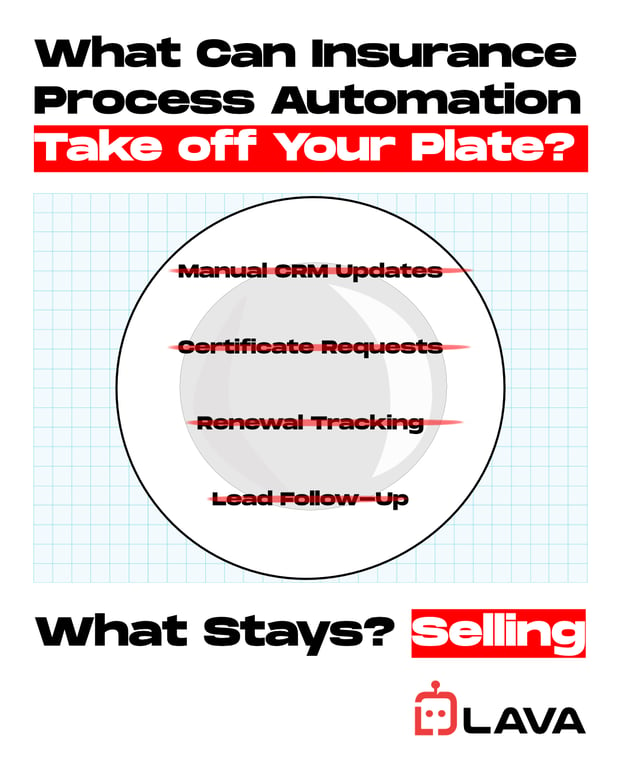
Insurance process automation targets the small, repetitive tasks that interrupt a producer's day without requiring their judgment or their license.
Here is what that removal typically looks like:
- CRM updates happen automatically after a call, quote, or client interaction.
- Certificate requests route through a defined workflow instead of landing in a producer's personal inbox.
- Renewal reminders trigger on a schedule based on policy dates.
- Follow-up sequences launch automatically the moment a lead enters the pipeline.
Insurance process automation removes the fragments of work that never required the producer’s judgment to begin with.
Not every task removed delivers the same return. Some, like renewal reminders, protect revenue that is already on the books. Others, like automated follow-up, create new revenue by catching leads before they go cold. Knowing which fragments matter most for your specific agency is what determines how quickly the investment pays off.
To understand exactly where insurance process automation delivers the fastest return inside a growing agency, read: Where Insurance Process Automation Makes the Biggest Impact
What Insurance Process Automation Looks Like Inside a Real Agency
Insurance process automation is a layer built around how a specific agency already operates, configured to work inside the CRM and AMS the agency is already using.
A well-built system integrates directly with the tools producers touch every day, so nothing requires a separate login or a second place to check for updates. It runs quietly in the background, triggering the right action at the right time without a producer having to remember that the action needed to happen at all.
The strongest implementations share a common trait. They are invisible to the producer in the best possible way. The producer simply notices that certificates go out faster and that leads get acknowledged within minutes rather than sitting untouched for a day.
A Producer's Day Before and After Insurance Process Automation
Here is what this looks like in a typical scenario. A ten-producer agency tracked one producer's day across a typical Tuesday before and after implementing insurance process automation.
Before automation:
- The producer spent the first 45 minutes of the morning manually updating CRM records from the previous day's calls
- A certificate request arrived mid-morning and required a 20-minute interruption to process
- Two renewal reminders were sent manually after the producer remembered to check the calendar
- The producer completed four prospecting calls before lunch
After automation:
- CRM records updated automatically overnight based on the previous day's call logs
- The certificate request was routed to a defined workflow without reaching the producer's inbox at all
- Renewal reminders had already gone out automatically three days earlier based on the policy dates
- The producer completed nine prospecting calls before lunch, more than double the previous volume
The fragments that used to consume the morning simply stopped reaching the producer.
What to Look for in an Insurance Process Automation Solution
Not every automation solution delivers the same result, and the difference usually comes down to how well the system was mapped to the agency's actual workflows before it was built.
Look for a solution that integrates directly with your existing CRM and AMS rather than requiring a separate platform. Confirm that the provider maps your specific workflows before configuring anything, since a generic template rarely performs the same way a custom-built system does.
Ask what happens to exceptions, the requests and situations that do not follow the standard pattern, since a system with no defined escalation path will eventually require just as much manual oversight as the process it replaced.
The strongest insurance process automation systems are the ones built around your agency's actual operation, instead of a generic platform.
Are Your Producers Underperforming or Simply Overloaded?
You came into this article wondering whether your producers were underperforming or simply overloaded. The answer is almost always the second one.
Insurance process automation removes the administrative tasks that were quietly consuming hours that should have gone toward selling. Once those are gone, the same producers who felt stretched thin suddenly have room in their day for the calls and conversations that actually grow the book.
At Lava Automation, we map your agency's specific workflows before a single piece of automation is configured, so the fragments removed are the ones actually costing your producers the most selling time. Over $4 billion in premium runs on what we have built across more than 300 agencies.
Most agencies that attempt to build this kind of automation on their own run into the same walls. To understand why expert-built automation consistently outperforms a DIY approach, read: Why Expert-Built Automation Outperforms DIY for Insurance Agencies.
Frequently Asked Questions
How does insurance process automation improve producer productivity?
It removes the small, repetitive administrative tasks- CRM updates, certificate processing, renewal reminders- that interrupt a producer's day without requiring their judgment. Once those are automated, producers recover hours that go directly toward prospecting and closing activity.
How much time do producers typically lose to manual administrative work?
Even 90 minutes a day in scattered administrative activities adds up to more than seven hours a week, nearly a full workday.
What should agencies look for when evaluating an insurance process automation provider?
Confirm the provider maps your specific workflows before building anything, integrates directly with your existing systems, and has a defined process for handling exceptions rather than leaving them to fall through the cracks
Topics:
