

Somewhere between the renewal that slipped and the certificate request that sat in a queue for three days, a producer lost hours they will never get back. The hours were lost to work that automation could have owned entirely.
The biggest gains from insurance process automation come from the workflows your licensed staff were never supposed to own.
Renewal reminders, certificate requests, CRM updates, and follow-up sequences that land on a producer's plate consume hours that should be spent selling and never get addressed because the agency keeps running even when they're open.
At Lava Automation, we have built insurance process automation systems inside more than 300 insurance agencies managing over $4 billion in premium. The pattern is consistent. The workflows consuming the most producer time are almost always the same, and the agencies that reclaim that time fastest are the ones that stopped treating high-volume manual tasks as unavoidable and started automating them first.
In this article, you will learn where insurance process automation delivers the most immediate return, which workflows create the most operational drag when left manual, and what changes inside an agency when the right processes start running automatically.
Why Small Tasks Are the Biggest Drain on Insurance Agency Productivity
The productivity problem inside most insurance agencies is the dozens of small ones compounding every day.
An agent who spends five minutes updating a client's policy details after every interaction loses more than eight hours a week to a task that automation could handle in seconds. Now multiply that across certificate requests, renewal reminders, CRM updates, and follow-up emails.
Every minute a licensed producer spends on administrative work is a minute they are not spending on policy decisions and new business development.
Insurance process automation reclaims those minutes by taking ownership of the tasks that repeat on a predictable schedule without requiring judgment.
What Insurance Workflows Should You Automate First
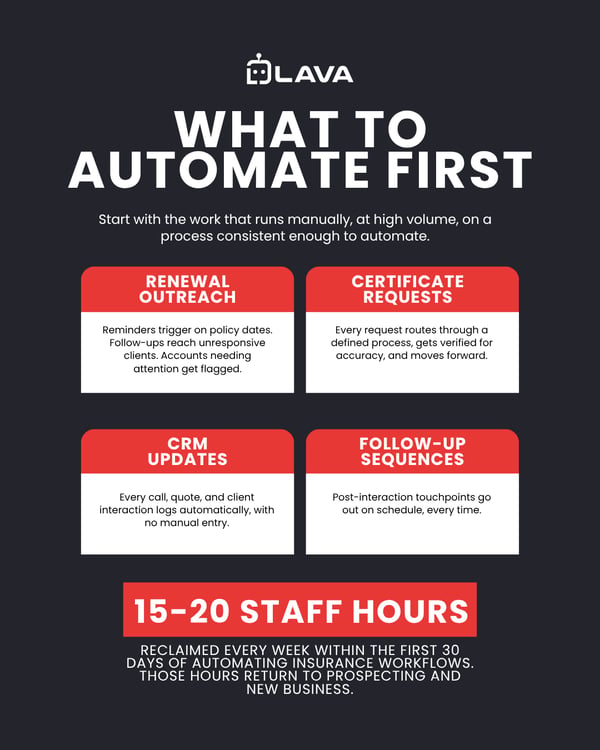
The highest-impact starting points share one characteristic: they run manually, occur at high volume, and follow a process consistent enough to automate without significant customization.
The workflows that deliver the fastest return when automated include:
- Renewal outreach — reminders trigger automatically based on policy dates, follow-up sequences go out to unresponsive clients, and accounts requiring human attention get flagged
- Certificate of insurance requests — every request routes through a defined process, gets verified for accuracy, and moves forward.
- CRM updates — every call, quote, and client interaction logs automatically
- Follow-up sequences — post-interaction touchpoints go out on schedule
Agencies that partner with automation providers like Lava reclaim 15 to 20 staff hours every week within the first 30 days of implementing insurance process automation. Those hours return directly to prospecting and new business development.
How Insurance Process Automation Reduces Errors and Compliance Risk
Manual processes carry a compliance cost that most agencies underestimate until something goes wrong.
A data entry error that propagates across systems creates hours of rework and potential regulatory exposure. A certificate with incorrect policy details creates liability before anyone catches the mistake.
These are predictable outcomes of workflows that depend on human memory and manual execution. Insurance process automation eliminates that dependency by building the compliance requirements into the workflow itself:
- Document verification catches errors before certificates go out
- Policy update syncing pushes changes across every connected system simultaneously
- Audit trails track every step of every workflow
- Defined routing rules ensure every request moves through the correct sequence
Every workflow runs the same way every time, creating a standard your agency can stand behind regardless of who handled the task or how busy the day was.
To understand whether your agency's current workflows are structured well enough to support this level of automation, read: How Do You Know if Your Insurance Agency Is Ready for Automation?
How Does Insurance Process Automation Improve Client Retention
A client who does not hear from your agency before their renewal date has time to wonder whether they are getting the best rate. Those who submit a service request and receive no follow-up start questioning whether the relationship matters.
Insurance process automation closes those gaps by owning the communication touchpoints that drive retention:
- Renewal outreach reaches every client before their expiration date, so no client has time to shop with a competitor without hearing from your agency first
- Post-service follow-ups arrive after every significant interaction, so every resolved request reinforces the relationship.
- Annual check-ins go out on every policy anniversary
The agencies that retain the most clients are those whose systems ensure no client goes silent during the moments that determine whether they stay.
How Insurance Agencies Scale Without Adding Staff Using Insurance Process Automation
Insurance process automation absorbs the administrative volume that would otherwise require an additional hire.
When renewal outreach runs automatically, the agency adds accounts without adding the staff time required to manage them. When certificate processing moves through a defined workflow, the existing team handles more volume without the workload scaling linearly.
The agencies that scale most efficiently automate the administrative layer before they hire into it.
The staff the agency hires spend their time on work that requires their expertise. The administrative layer that was consuming their hours now has a dedicated owner.
Where Insurance Process Automation Fits Into Your Agency's Growth Plan
The workflows consuming the most producer time inside your agency are almost the same ones that consume time in every agency at your stage of growth. This could be a renewal outreach that runs on memory or follow-up sequences that depend on whoever has a free moment.
These are the workflows that insurance process automation was built to own, and they are the ones that deliver the fastest return when automated because they are already happening at volume inside your operation.
When insurance process automation owns the administrative layer, your licensed staff start spending their hours on the activity that builds the book and grows revenue.
At Lava Automation, we build insurance process automation systems inside your existing AMS, CRM, and carrier workflows, then pair them with trained virtual assistants who handle the exceptions automation cannot resolve. Over $4 billion in premium runs on what we have built across more than 300 agencies.
Most agencies that implement automation without the right support structure run into the same problems. To understand why combining virtual assistant support with automation consistently outperforms automation alone, read: Why Insurance Agencies Use Virtual Assistants with Automation.
Frequently Asked Questions
Where does insurance process automation have the biggest impact in an insurance agency?
Renewal outreach, certificate processing, CRM updates, and client communication touchpoints deliver the fastest return. These workflows are high-volume and consuming licensed staff time that should be going to selling activity.
Can insurance process automation help agencies scale without adding staff?
Automation absorbs the administrative volume that would otherwise require additional headcount. Agencies that automate the administrative layer before hiring into it scale more efficiently and maintain stronger profit margins as the book grows.
How does Lava implement insurance process automation inside an agency?
Lava builds automation around your existing AMS, CRM, and carrier workflows, then pairs it with trained virtual assistants who handle the exceptions automation cannot resolve. Every system is configured around your agency's specific processes.
Topics:
