

Are renewals happening later than they should inside your agency?
Do client follow-ups depend on memory, inbox scanning, or whoever has time that day?
Many growing agencies experience declining retention that stems from inconsistent execution, delayed renewal outreach, and licensed staff stretched thin by administrative work.
At Lava Automation, we have supported hundreds of insurance agencies managing billions in premium by building structured automation systems paired with virtual assistant execution that create predictable renewal timelines and stronger client retention.
In this article, you will learn why client retention breaks down in growing agencies, how structured automation supports predictable service, and how execution ownership protects revenue over time.
Why Does Client Retention Break Down in Growing Insurance Agencies?
Retention rarely declines because clients dislike their agent. It declines when execution becomes inconsistent.
Client retention depends on predictable renewal and service workflows.
Common breakdown points include:
Renewal outreach beginning too late
Follow-up tasks without clear ownership
CRM documentation was completed inconsistently
Service backlogs during peak periods
As agencies grow, volume increases—licensed staff balance sales, service, and oversight responsibilities. Renewal timelines drift. Conversations happen closer to expiration dates. Fire drills replace proactive planning.
Last-minute remarketing compresses negotiation time and reduces strategic positioning.
Retention pressure reflects operational inconsistency.
How Does Structured Automation Improve Insurance Client Retention?
Automation strengthens retention by introducing structure and timing into critical workflows.
Structured automation creates predictable renewal engagement.
Retention-supporting automations often include:
Renewal timelines are triggered 45 to 60 days before expiration
Task routing for remarketing and coverage reviews
Automated reminders for outstanding documentation
Service request tracking with visible completion status
Predictability builds trust. Trust supports retention.
Agencies that begin renewal conversations earlier often experience greater renewal confidence and higher year-over-year retention rates.
Why Is Licensed Time Protection Central to Retention?
Licensed staff provide advisory value. Administrative work limits their ability to engage clients strategically.
Protecting licensed time strengthens renewal conversations and reinforces advisory authority.
When licensed producers spend significant time tracking tasks, verifying documentation, or resolving incomplete workflows, renewal discussions are delayed until later in the cycle.
Structured automation paired with execution oversight allows licensed staff to focus on:
Coverage reviews
Risk discussions
Cross-line opportunities
Proactive client communication
Earlier advisory conversations improve positioning and protect long-term revenue.
Why Automation Alone Does Not Guarantee Retention
Automation introduces triggers and task creation. Agencies still require execution ownership.
Execution ownership ensures that renewal workflows are completed as designed.
Workflows that lack monitoring accumulate incomplete tasks and data gaps. Renewal sequences stall during busy periods. Licensed staff re-enters processes to restore momentum.
Many agencies assign a trained virtual assistant or operations lead to monitor renewal timelines, verify documentation, and ensure follow-through. This execution layer maintains consistency and protects retention performance.
Retention improves when automation and human accountability operate together.
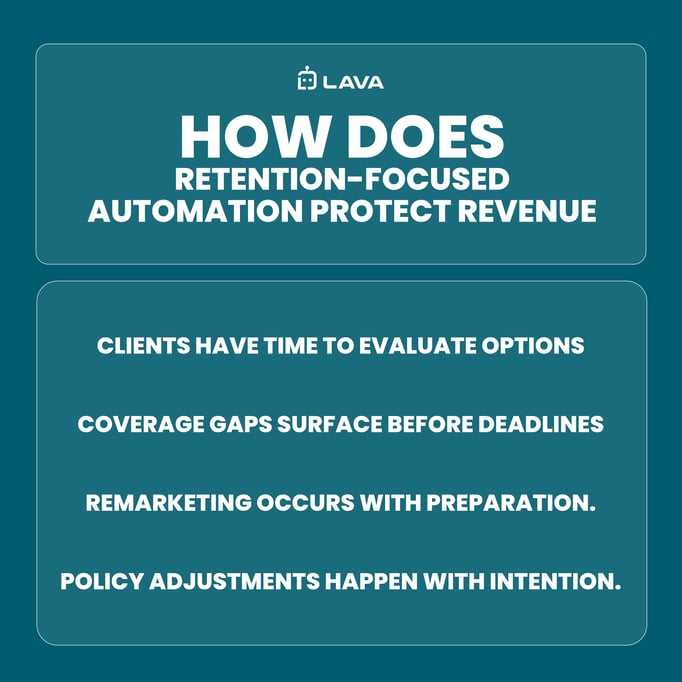
How Does Retention-Focused Automation Protect Revenue?
Retention directly supports agency stability and forecasting confidence.
Early renewal engagement reduces last-minute pressure and supports stable revenue performance.
When renewal conversations begin earlier:
Clients have time to evaluate options
Coverage gaps surface before deadlines
Remarketing occurs with preparation.
Policy adjustments happen with intention.
Agencies experience fewer reactive renewals and fewer rushed negotiations near expiration.
A one-point improvement in retention rate can protect significant recurring revenue across a growing book of business.
Retention results from consistent operational design.
What Does a Retention-Focused Automation Strategy Include?
A structured retention strategy typically includes:
A documented renewal timeline
Automated task creation tied to expiration dates
Clear execution ownership for follow-up steps
Monthly review of renewal start dates and completion rates
Leadership visibility into renewal performance supports stronger forecasting and proactive decision-making.
Retention becomes measurable and manageable.
Strengthening Client Retention Through Structured Execution
You may have started this article to improve client loyalty. You now see that retention reflects operational consistency, renewal timing, execution ownership, and time-protected licensed time.
A practical next step is to review your current renewal timeline and identify where follow-up tasks rely on manual reminders or informal tracking.
Retention improves when renewal workflows operate predictably and consistently.
At Lava Automation, we help agencies build structured automation systems supported by trained virtual assistants who own execution and protect licensed time.
Book a demo to explore how retention-focused automation can strengthen your renewal process, protect recurring revenue, and support long-term agency stability.
Frequently Asked Questions
How does automation directly impact client retention?
Automation improves retention by introducing consistent renewal timelines, structured follow-up tasks, and predictable communication patterns.
Can automation improve renewal timing?
Yes. Automated renewal sequences trigger tasks and reminders based on expiration dates, ensuring outreach begins earlier and progresses consistently.
Why is licensed time important for retention?
Licensed staff provide advisory value during renewal conversations. Protecting their time enables earlier engagement, stronger positioning, and greater confidence in retention.
Does automation replace service staff?
Automation supports workflow movement and task routing. Agencies continue to rely on human oversight for verification and client interaction.
What is the first step in building a retention-focused automation strategy?
Document your renewal timeline and identify where tasks lack ownership or consistent tracking. This creates clarity before introducing automation triggers.
Topics:
